
 As the Junior Art Editor of the Fall 2017 issue of Élan, one of the pieces I reviewed that resonated with me the most would be “Wind Up Boy”. Stylistically, one can see how it can catch a viewer’s gaze. The artist very masterfully creates a face for the portrayed character, immediately drawing attention to the rest of the piece and its meaning. The color scheme and the position of the boy also work to add a layer of depth to the message. To fully understand the striking aspects that the artist is able to convey in this piece, it must simply be seen through its original medium, as I do not believe a recreation of it through words will be able to truly illustrate its traits.
Though the meaning may vary for others viewing the piece, I believe the most resonating intent to be pulled away is the idea that this boy keeps having to wind himself up again to function. However, considering how his key is in his back, I am led to believe that it is someone else he depends on to turn this key for him. In this, he is unable to motivate himself to be productive unless another he relies on keeps him standing and walking forwards in a thoughtless, mechanical manner. When all of the turns of the key are used up, the boy simply falls again in exhaustion. He possibly contemplates never standing again. In this, I believe specific image can strike many viewers in a meaningful way. I find this piece to not only be well done, but to be carrying universality as well.
I believe the reason this piece is so intriguing to me is because I feel I can relate to the boy in this period of my life. As an upperclassman in high school, I realize the looming responsibilities following graduation and the possibilities of further education. Not only is there a decision to be made, but there are also obstacles of others expectations for you and the thoughtless mistakes of your past holding you back. Currently, in preparation for college, I have found myself swamped in activities inside and outside of school. This is done in order to further accomplishments that may be listed on my college applications. Often times, however, after I work so hard on something with no immediate result, it can become exhausting to continue. Whether it be a supportive friend or a good coffee, I find that I am often in need of something or someone to simply wind me back up. This way, I can again continue on my way towards the future I want by using the mechanical methods the key dictates. Though I realize it is an exhausting way to live, I still continue towards my goals in life. In a sense, this piece reminds me of this struggle and the fact that it is possible to move through it. Though exhaustion follows all your ventures, it is rare that you are left without anything to help one continue moving forwards. The artist of “Wind Up Boy” ironically demonstrates it as she clearly worked tirelessly to create this image of giving up, reflecting an emotion she must have felt before or during the creation of this piece of art.
This piece can then, through its universality, possibly be able to reflect the states of artists submitted into Élan. Without the ability to be wound back up again and to continue work, we may not have made it as far as we have today.
–Kathryn Wallis, Junior Art Editor
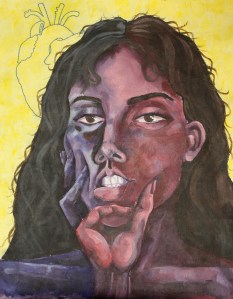 Being a writer, I am always looking for a sort of inspiration and depth; images that delve into the mind and explore the deepest desires within us all. This is exactly the reason I chose the piece Blank by Jasmine Hernandez as my favorite art piece. Not only does Blank split the idea of love open under a microscope, but the artist uses contrasting colors and vivid detail to engage the reader and tell a story no one else can. In it, I see the idea of human connection. The heart, which has always seemed to embody the emotions hiding within us, is in the exterior bringing into question a subtle battle between external and internal that I am too familiar with as a writer.
 One of my favorite art pieces from the Fall 2017 edition of Elan is “Tranquility” by Kaylin Hillman. Coincidentally, it happens to be the first piece of the art in the book, which I think was a great choice. This piece is generally a very visually appealing one, especially with the blend of colors, but I think it represents much more than that as well. This piece is important to the current events going on throughout the world, all rooted to the connection of humans. There are so many human rights movements and huge decisions being made in the community right now that I think this was a perfect piece to be accepted into this issue.
 elanlitmag.org