Creating from Nothing

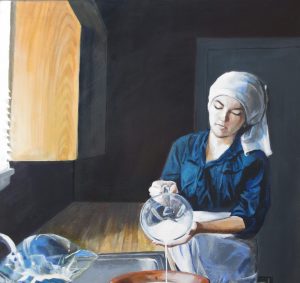
Whenever my eyes used to come across “Milkmaid” by Eryka Goldsworthy, it struck a familiar chord. I’d find myself staring at all aspects of the painting, the way the wood contains small looped circles and the bread reflects the light coming from the window. I believe that this painting resonated with me because it focused on a small action, something simple, a snapshot of milkmaid. The inspiration for this painting had to have come from the oil painting by a Dutch artist in 1658, also called “The Milkmaid”. The biggest differences between the two paintings is notably the setting. The painting done by Eryka is much more modern, the milkmaid is pouring milk in ceramic bowl on the edge of a stainless-steel sink.

            From the hues to the Milkmaid’s expression, there is no question that the painting is organic. It illustrates an overall feeling of home coming from a creator. I believe that any entrepreneur, cook, farmer, writer, painter, can relate to feeling radiated by the painting. Writing takes places first in the home and when I look back at my earliest memories, some of my writing took place while watching my mother cook in the kitchen. Paintings like “Milkmaid” exhibit a feeling grounded in the roots of any culture. Writing involves reaching into memories to explore more about oneself, whether it was a good or bad period in our life. It is a good feeling to know that the emotions behind a piece are true, and they can be true to anyone.

One of my poems describes how I used to watch my family work at the back of a restaurant, elbow grease and all. I think that “Milkmaid” resonated because it reminded me of an actual memory at a very young age. Paintings that take me back to a certain point in life inspire me to create something from nothing. Personally, “nothing” is a state of mind or a plateau for an artist.  Creating something out of nothing is when my best ideas take place. Last year, “Milkmaid” pulled me out of a plateau with writing that I was going through and inspired me to create a creative nonfiction story about the milkmaids of Colombia. I have found myself always writing about small actions in my daily life, mostly because it amazes me how differently I can experience them.

The Elan literary magazine publishes nothing but organic work. Our paintings like “Milkmaid” exhibit a profound candid expression. The action of the milkmaid is a lot similar to other pieces that Elan publishes, it makes writers like myself reflect on a memory to create something memorable.

Evelyn Alfonso, Poetry Editor

Suffocation of Something Beautiful

Of all the beautiful artwork published in Élan, the piece that resonated that most with me is probably Slow as Molasses by Isabella Gardner. Not only are the aesthetics of this piece incredible, but the different meanings that could be behind it, how it connects to the pieces on either side of it, and how it connects to Élan as a whole are all amazing.

How this piece looks visually on the page is both intense and beautiful. While it’s drawn completely in black and white, the contrasts between the woman, the wall behind her, the bee, and the molasses dripping from her head allows for a lot of interpretation about light and color, even without those being present in the piece. The details of the woman’s lips and eyes allow for a lot of interpretation about what’s happening in the work; while the bees, which are often seen as symbol for discovering personal power, and the woman’s facial expression, which looks somewhere between self-discovery and pain, she’s also drowning in molasses, something incredibly sweet. Despite bees having stingers, the woman looks as though she’s being awakened as she’s being drowned and stung, and despite its ambiguity, the piece allows for a lot of personal interpretation. I personally see the work as a representation of how we often drown in our own vices and pleasures.

The piece also pairs incredibly effectively with the pieces around it. Altar Serving by Jaclyn Berry explores a girl finding pleasure in a time of intense emotional pain and stress, and Recipe for Baked Potato by Noland Blain explores themes of suffocation and the painful, unhealthy aspects of something delicious. As well as being one of the most thoughtful and beautiful pieces we’ve ever published, I think part of the reason it stands out in my mind is how it complements the writing and brings out themes in all three of the pieces that may not have been clear without the pairing

I also feel as though this piece epitomizes the message of Élan. We try to select pieces for our books that we feel are not only thoughtful and aesthetically pleasing, but also pieces that invoke an emotional reaction in the reader and that explores themes deeper than what’s merely on the surface. This piece allows for a vast amount of interpretations, is beautiful on the page, and totally fits in with the theme of the entire spring 2017 edition.

Oona Roberts, Senior Layout and Design Editor

Exhaustion Personified in Paint

As the Junior Art Editor of the Fall 2017 issue of Élan, one of the pieces I reviewed that resonated with me the most would be “Wind Up Boy”. Stylistically, one can see how it can catch a viewer’s gaze. The artist very masterfully creates a face for the portrayed character, immediately drawing attention to the rest of the piece and its meaning. The color scheme and the position of the boy also work to add a layer of depth to the message. To fully understand the striking aspects that the artist is able to convey in this piece, it must simply be seen through its original medium, as I do not believe a recreation of it through words will be able to truly illustrate its traits.

Though the meaning may vary for others viewing the piece, I believe the most resonating intent to be pulled away is the idea that this boy keeps having to wind himself up again to function. However, considering how his key is in his back, I am led to believe that it is someone else he depends on to turn this key for him. In this, he is unable to motivate himself to be productive unless another he relies on keeps him standing and walking forwards in a thoughtless, mechanical manner. When all of the turns of the key are used up, the boy simply falls again in exhaustion. He possibly contemplates never standing again. In this, I believe specific image can strike many viewers in a meaningful way. I find this piece to not only be well done, but to be carrying universality as well.

I believe the reason this piece is so intriguing to me is because I feel I can relate to the boy in this period of my life. As an upperclassman in high school, I realize the looming responsibilities following graduation and the possibilities of further education. Not only is there a decision to be made, but there are also obstacles of others expectations for you and the thoughtless mistakes of your past holding you back. Currently, in preparation for college, I have found myself swamped in activities inside and outside of school. This is done in order to further accomplishments that may be listed on my college applications. Often times, however, after I work so hard on something with no immediate result, it can become exhausting to continue. Whether it be a supportive friend or a good coffee, I find that I am often in need of something or someone to simply wind me back up. This way, I can again continue on my way towards the future I want by using the mechanical methods the key dictates. Though I realize it is an exhausting way to live, I still continue towards my goals in life. In a sense, this piece reminds me of this struggle and the fact that it is possible to move through it. Though exhaustion follows all your ventures, it is rare that you are left without anything to help one continue moving forwards. The artist of “Wind Up Boy” ironically demonstrates it as she clearly worked tirelessly to create this image of giving up, reflecting an emotion she must have felt before or during the creation of this piece of art.

This piece can then, through its universality, possibly be able to reflect the states of artists submitted into Élan. Without the ability to be wound back up again and to continue work, we may not have made it as far as we have today.

Kathryn Wallis, Junior Art Editor