
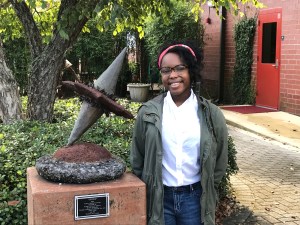
 I am two years past my first Writers’ Festival and the experience still heavily influences how I write as well as how I view myself in the scheme of the literary community. I went into the day worried that I would be distant from the writers. I’d have to elbow through adult strangers just for the chance to brush Tracy K. Smith’s garment… then maybe, just maybe, I would absorb some of her holy knowledge. This was not an accurate prediction. Every writer, from alumni, to local favorite, to headliner was dedicated to make connections with the attendees of the festival. This along with the festivals intentional design made for an incredibly intimate experience. The writers took us in as their own students and brought us powerful lessons that not only shook my approach to writing, but had me leaving each workshop with a new piece of writing.
The writer I was anticipating the most in the months leading up to Writers’ Fest was Jessica Hendry Nelson. Like all of the featured writers, she is wholly unique. In my freshman year our class read “Rapture of the Deep” for a lesson in creative non-fiction. From there I began reading her book and just fell in love. She wields language in a way that does not wring meaning from tired syntax. In creative nonfiction I found myself constantly trapped in the cycle of retelling mystery then adorning it with sparkling language and colorful images. This method is like beautifying a corpse before burial.
Jessica does not just clip pretty pieces to a dead thing. In her workshop she taught us how to extract vivid details from our experiences. We received practical instruction on how to use specificity to reveal a deep, meaningful reflection of each moment. She taught us how to avoid vaguely reflective narration and instead allow carefully selected details to advance the physical and emotional narrative.
Jessica Hendry Nelson moves memoir through brilliant bursts of syntax like a flash of light. Striking the eye unexpectedly and leaving you momentarily blind. Forcing you to blink your way to insight. After her workshop I feel I am a step closer to doing the same. At the end of the day I was able to personally express my gratitude to her and she responded with a hug. I very poorly concealed how overwhelmingly ecstatic I was.
One can not overstate how impactful Writers’ Festival is to the young writer. It is an opportunity to (in many cases literally) brush shoulders with what could be their future. The organizers of Writers’ Festival do such a masterful job of showing writers with incredibly diverse styles at different points in their careers creating in very different ways. For me it was a powerful push of encouragement confirming that at heart I am a writer and no matter how that manifests itself for me there is a place for everyone in the literary community.
– Ashley Chatmon, Senior Marketing Editor
 I had my first Writers’ Fest sophomore year. Admittedly, I didn’t know what to expect. I was still developing my craft during that time and hadn’t broke through that creative surface. I struggled with accepting my writing as my own, creating stories and stories that didn’t entirely tell my truth.
 I was able to go to Douglas Anderson’s Writers’ Festival for the first time when I was in my sophomore year of high school. When I looked through all the authors and their workshops I had a hard time picking which ones I wanted to go to, as I found each one interesting. One that stood out to me immediately was Jim Peterson’s workshop called the Jazz Method of Poetry. The workshop was about connecting writing poetry to playing jazz, and I knew once I read the description that I wanted to go.
 elanlitmag.org