
 Nature and writing have the same long beautiful process. The years it takes to grow a tree, the bee that pollinates the flowers, a lake so vast, but so small all at once. In nature I am constantly reminded just how small we are, how there is a much bigger picture than my tiny problems, this process humbles my writing. After seeing something so simple, and beautiful my work expands to reach out to more than just what I am feeling. Nature inspires me to write for others. Often I write based on my own personal truths, but realizing that each personal truth has a universal experience if the right elements are added, makes poetry that much stronger.
Poetry is writing with color. Sensory detail and texture can make an okay poem great. Nature is the land of color. Taking a moment to sit outside one can see things they take for granted in everyday life. The sun peeking through the trees, the ant carrying a crumb on his back, a flower coming to full bloom. Natures distinct sound, makes it hard not to be inspired. Some of my best work has come from questioning the soil I plant my feet in to. Who was here before me? What stories were told? Is this land a place once filled with horror? Or is this land a place filled with happiness? Who has the right to this land? What gives land the right to be owned?
Looking at nature as what it was rather than what it has become is a great way to think of writing. It’s bellow the surface that the story really begins to shape. Nature is also a reminder that with out us, the sun will still rise, the waves will still crash along the shore, life will go on. That is the impact I strive for my words. Something that once when I am gone, is a legacy I can leave behind. We still study the works of great artist who have passed, with out their art what would be remembered?
A great poetry prompt from writingforward.com “A young girl and her mother walk to the edge of a field kneel down in the grass and plant a tree.” Imagine why they might be planting the tree, is this a ritual or a first time? What is the dynamics of their relationship? Use imagery and diction to really convey the moment.
–Mary Feimi, Editor-in-Chief
 Reading poetry is one of the most important aspects of being able to create your own. You could just constantly create and figure out how to improve using some version of trial-and-error, but the consumption of poetry allows for technical exploration and understanding, and most importantly, it can give you permission to say what needs to be said.
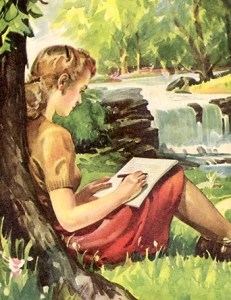 I’ve lived in the same house since I was six years old. As I was growing up and beginning to write, I was discovering the world at the same time, often through the same outlet. I’d find myself walking around my backyard, which is an acre of woodsy land, looking for inspiration. One day I came across a tree I hadn’t seen before; it was huge, with the perfect dip in the grass at the base of the trunk for me to lay a blanket down and stretch across with a notebook. That spot quickly became a safe haven for me, where I would escape to journal about my day or write to distract my mind.
 elanlitmag.org