
 I was really inspired by “Icarus Drowning” by Isabella Tolbert. I just love how she took the story of Icarus and expanded it. She took the story and ran with it and at the same time kept the natural authenticity. Everything explored in the poem went along with the story. Nothing felt out of the blue.
It’s very important when you’re completing a myth or writing an ekphrastic piece of work to put yourself into the story or the story’s mindset. Tolbert clearly placed herself inside the myth of Icarus and Daedalus she was exposed to and carefully developed the rest. I’m particularly impressed with the point of view of the speaker. If she was referring to the myth, then it’s only natural she kept the third person omniscient point of view. However, if she was inspired by the painting of Icarus drowning, I wonder why she didn’t use another point of view for example, the point of view of Icarus or Daedalus. I wonder what else she could’ve explored if she used a different point of view. Throughout the poem the voice of the narrator was very consistent and strong. I enjoyed how the narrator lightly sprinkled in detail till the final moment, which punched me in the stomach, “This childhood fascination/ Of the sun wasn’t the only thing/ He needed to be afraid of”. I love the use of line breaks Tolbert used in her poem. Her use of line breaks worked in her advantage when it came to controlled ambiguity. For example: “Falling, he reached out/ For his father, too far/ Ahead to hear his son calling out to him”, And: “The weight of an entire lifetime/ Left to live. Hours pass, / Minutes lingering on like stains on satin sheets,”. Tolbert really did a great job executing craft in this poem. I was engaged throughout even at the last line I wanted more. This poem inspired me because I was connected the craft.
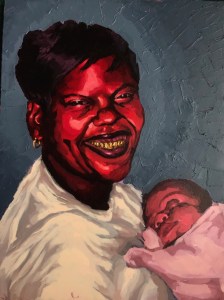
I’m also inspired by Madonna and Child by Larry Fullwood. This painting is so eye grabbing. I love the basic colors he used to compliment each other. The blue in the background gives off an innocent/ angelic vibe for the baby and Madonna. What particularly caught my attention is the people in the painting are African American. This piece is depicting them in a positive light, and that’s why I like this piece so much. It inspired me to write a positive poem about the African American community.
There’s a great selection of art and writing out in our Fall Edition I’m sure you’ll easily find a piece of writing and/ or art to inspire you so feel free to explore.
– La’Mirakle Price, Junior Managing Editor
 “Portrait with House” by Marin Hart is a short eleven-line poem that packs heavy emotion throughout each description. I am fascinated by the use of hanging indentation, how it switches the perspective in a noninvasive manner. The poem opens with a strong line, using the verb “invade” to describe the events. Already, readers get a sense of what type of actions we’re going to read. The entire poem, though it is short, reminds me of a distant relative or friend who I still haven’t come to terms with for their actions, and now I have to face them. I must confront them like the speaker. Each line either utilizes figurative language or direct imagery, neither of which fall short. The poem itself is its own metaphor, liking the house to a creation or idea that the “she” has ruined. I find this to be intriguing, often larger metaphors are drawn out, require more time to be understood, but this poem doesn’t need elaboration because of the language given. The speaker of the piece is certain of their own actions and what the “she” is doing.
 It is so rare that a poem leaves me with questions that I don’t mind asking. When I read Marin Hart’s “Portrait with House” during the initial reads process, I was shocked by the delicacy and precision with which the impulses were executed. I finished and wondered what exactly I had just experienced, as this poem is one of those that is felt before it is understood.
 elanlitmag.org