
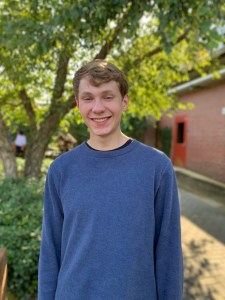
 As a freshman at Douglas Anderson, I experienced my first Writers’ Fest on a whim, oblivious to the work that goes into the event. Something that I did notice, despite my naive nature, is that the writers had a lot of interesting and thoughtful things to say. They spoke to me in few ways people do; they listened to my innermost questions when it came to writing, and provided answers I still use today in my work. One of those people, specifically, was George Saunders.
George Saunders and Tracy K. Smith were the headliners that year, and I went to both of their lectures. Coming out of both, I gained valuable information that is universal to my work.
George Saunders had a wonderful question and answer section, which let writers ask questions that matter to them, and lets them receive a response from a world-class, bestselling author. One of the questions that came up in the question and answer section was simple: what does writing mean to you?
His answer, unlike many public figures in today’s world, did not try to avoid the subject matter. He took it head-on, thoughtfully, and left us with something deep to think about. Writing is not putting words on a page, it is communicating a message in a universal way, and benefits society in ways that few other methods do. It strengthens our bond with our own humanity, and creates new ones with other people. Not only does it do justice to the questions of our conscious, it implements a major rule in our lives: don’t hold anything back.
Hearing this, the last few words reminded me of a poster that hung, and still hangs, in my creative writing classroom: “Go so deep into yourself, you speak for everyone.” – Galway Kinnell.
Through this immaculate response, I now use this method and way of thinking about writing every time I pick up my pen. If it is going to be something more meaningful than a fun read or a stream of consciousness, it needs to hint at a deeper message. It needs to speak to people and let them leave with something meaningful. Good writing lets words jump off the page, and stick in the reader’s mind for a long time. Couple that with an important message, and suddenly we’ve made a monumental change in the world with only some words, some paragraphs, some pages. It fills in the holes we have as humans, and it lets us fumble without feeling we’ve failed. This is what writing now means to me, thanks to that simple question and a beautiful answer.
George Saunders was not the only writer that made a meaningful change in the way I view writing, and, therefore, the way I view life. Other writers made meaningful comments and showed us techniques that I still use daily.
It is through these conversations that I had with wonderful writers that made me the person I am today, and that is all thanks to the Douglas Anderson Writers’ Fest. Without it, I would never have gotten the opportunity to experience such wonder and skill. I am still thankful to this day, and with a new Writers’ Festival coming up, I’m looking forward to being there.
– Jasper Darnell, Junior Layout & Design Editor
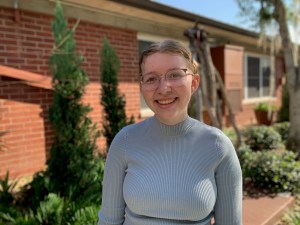 One of the most meaningful workshops I went to, was accidental. I had heard from one of my classmates that an essayist was going to be in a room upstairs and across campus, when I had gotten there, a small sign on the door told me she was moved downstairs and back across campus. With two minutes left to get in a class and me, being a small anxious 9th grader, didn’t want to walk into a workshop late, have everybody’s eyes on me and leave a bad first impression. So, I turned around to the next door, hoping that there was a workshop going on in there. It was Teri Grimm’s workshop, a local poet, who I hadn’t paid any attention to before that very moment.
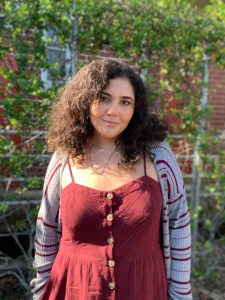 The first time I engaged with the inspiriting vulnerability, the transient warmth of Yvette Angelique Hyater-Adams, I was wandering Douglas Anderson’s 2018 Writers’ Festival. It was my sophomore year, and I, a naive and craft-study-suckling, self-proclaimed “poet” had willingly been at the mercy of an artistic puberty that most creatives know all too well— beginning to feel changes, such as my eyes sharpening to find real-world images, metaphors, poems, and noticing more and more often a prick in my heart that felt something like bee teeth: in those moments leaking the sticky, honey-esque sealant that bound me (hostage as a house guest!) to the unconditional love of Writerhood.
 elanlitmag.org