All you need is prose! (and poetry)

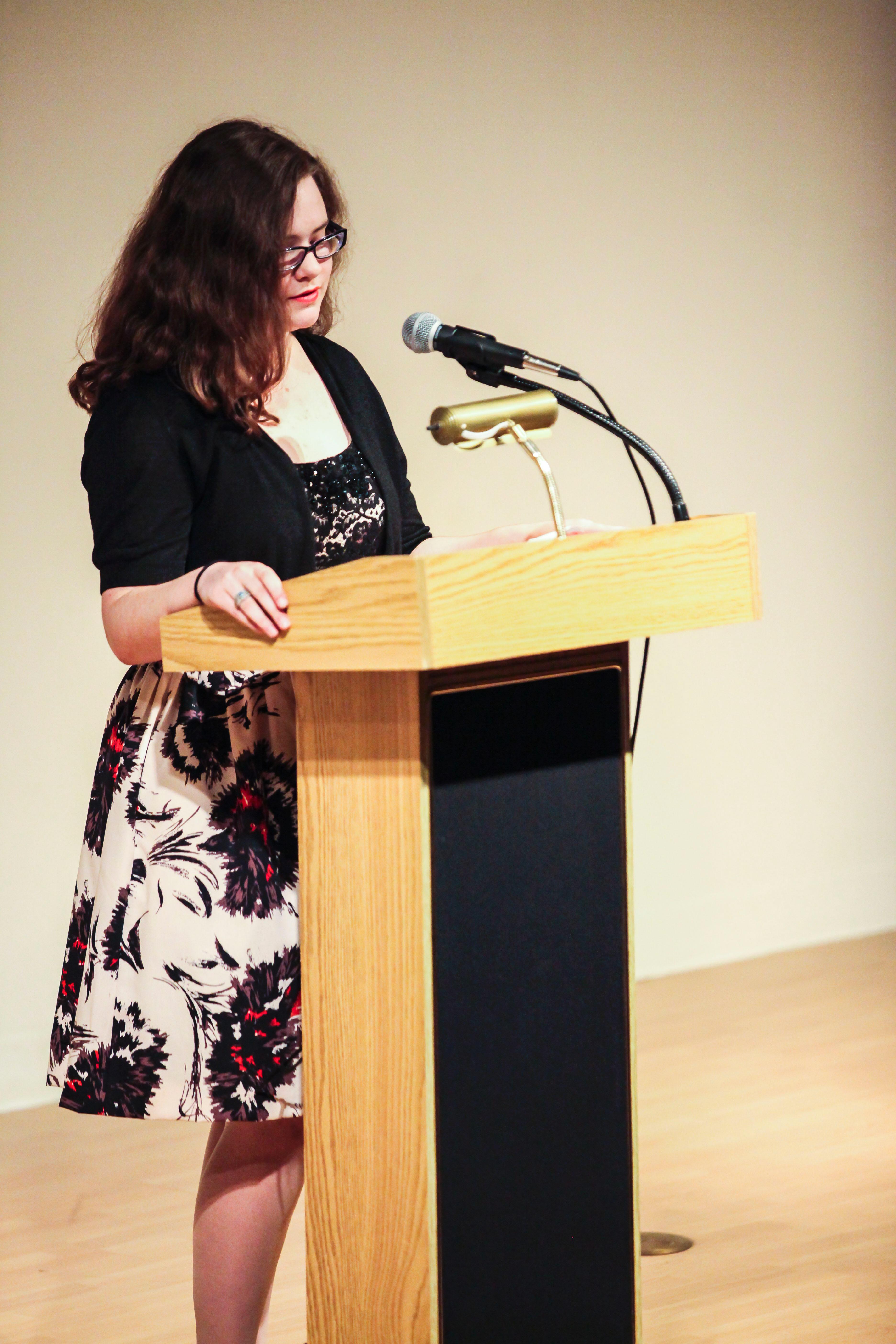
Senior Reading at the Museum of Contemporary Arts, Jacksonville.

Sarah Buckman at the Senior Public Reading. Hosted by the Museum of Contemporary Arts, Jacksonville.

Right now, I am in poetry mode. In school (and at home), I am still writing poetry about weather and what people have lost, and to be honest, it can be really hard to translate that into “fiction mode.” It’s harder than it seems to switch from line breaks and meaningful pauses to paragraphs and key words. But the key to doing anything is practice. My advice would be to write prose poetry if you are having trouble connecting back to fiction. A prose poem is a poem in all aspects, except it looks exactly like a prose piece. This can be very helpful, as the form of the poem can help stir your mind about “past fictional experiences.” Sometimes just seeing a poem in the form of fiction can help to move that block in your head that’s screaming “Poetry, give me Poetry!” This is a really effective way to change your view on prose. You can still use some poetic technique in fiction. Imagery? That is what keeps fiction going, and don’t even get me started on characterization. Another method to get into fiction mode: read fiction. It sounds simple and it is! Anyone who wants to be better in their craft should read what the professionals write. It just makes sense to read a piece by one of the masters if you want to be a master one day too. So go out and read some fiction. Search a topic that interests you and find a piece that is about that topic. Or find your favorite fiction writer and read their work. What you want to do is immerse yourself in what you are writing. If you always have trouble with plot in your fiction writing, read an author who has great plot technique. By immersing yourself in the classics, you will find your writing getting better over time. So to review, write some prose poetry to help your brain get into the fiction mindset, and read fiction! Once you immerse yourself in the world of fiction, you may just find it hard to leave!

– Sarah Buckman, Editor-in-chief

Human Interaction

Savannah BP pic 2

Okefenokee Swamp. Folkston, GA. Everyday life

There are some people that without ever having met, you just know. You watch their movie or hear their music and you just think “I relate to you; we could be friends, even.” You know facts about them and try to emulate their positive traits. This is most common with celebrities, specifically those who are masters of our individual trade. Athletes look up to other athletes, writers to other writers, businessmen to Donald Trump. As a writer –and a teenage girl- there are many people that I idolize and from them draw inspiration. I tried to think of the one person who inspired me the most, who handed me life’s lessons one at a time until I really felt that I found my footing. If you talk to as many people as I have, you’ll realize that this is nearly an impossible task.

I thought that I could cite Emily Dickinson, who made me first want to be a poet with “Hope is the Thing With Feathers,” or Mrs. Melanson who taught me to be who you are unapologetically, even if at times that means you have to be a little cynical. I thought about my mother, who –despite her shortcomings- implanted within me a set of morals that can’t be messed with, no matter who I talk to or what I do in my future. I started jotting down every Walt Disney fact that I know. How can one not draw inspiration from the original voice of Mickey himself?

But then I realized that maybe I don’t have to write a miniature feature on any one individual. We learn from one another all the time; that is the silver lining of constant human interaction. During the hum drum of day to day life, we steadily gain lessons from those that we watch on TV, those who we read in books or on websites, if we only keep our eyes and ears open.

-Savannah Thanscheidt, Web Editor 

When We Least Expect It

stephanieThey told me that you can never run out of ideas. That writer’s block was a myth. That you can find inspiration if you just try enough.

I wish that they had all told me the truth.

My biggest concern last year when I was going to be the marketing editor was how was I supposed to come up with creative ideas whenever I wanted to. And now—two commercials, a stockpile of merchandise, and one print book later—I still sometimes worry. Sometimes my fellow members of Élan come and ask me for marketing strategies. They do not know that inspiration rarely comes when I want it to, and sometimes it doesn’t even come when I need it to.

I always want the ideas—for writing, for marketing—to come immediately; I want them enter into my mind before I lost the hunger for them. I want to digest them before I forget how the creative spark tastes in my mouth.

When I was younger I didn’t have strict boundaries of homework, school, and deadlines. As a senior, I’ve lost some of that urge to be spontaneous, to be willing to sacrifice so much for the sake of something so simple, like finding out what happened to Harry, or if Percy made it to the labyrinth. I used spend hours beneath the covers with a book propped between my elbows, so that I could hold the flashlight and not have to worry about the pages turning on their own accord.

I’ve found that sometimes inspiration comes to us when we least expect it; it guides us along the raging rapids of our thoughts so that we can plan the next Homecoming commercial or create a new t-shirt design or even just help a fellow Élan staff member with their marketing goals.

-Stephanie Thompson, Head of Marketing