
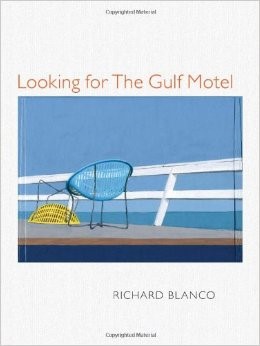
 As I lay curled up in an armchair reading Richard Blanco’s third book Looking for the Gulf Motel, I was struck by his diversity and approach. In my personal life, when my writing suddenly shifted towards interactions with my father and references to Mexican culture- I housed a fear that I would be pigeon holed. Surely no one wanted to read ten poems all dealing with my father, and italicized Spanish words. However, words like chiles and tortilla popped up again and again, along with whole lines of dialogue in Spanish.
Somehow,- it wasn’t enough, just to talk about my father and discovering culture. There had to be something else, a layer or theme hiding from me I hadn’t explored yet. Blanco poetry showed me just that. Knowing he was a Cuban writer, I expected unbridled praise for his culture, imagery upon imagery of joyous family gatherings, and ethnic dishes. It wasn’t quite what I imagined.
Reading the poem for which the book is named, I realized there was so many other layers to exploring culture. In the poem he touches on the intricacies of poverty, shame and trying to exist in a society that is not completely forgiving. Amidst this, he celebrates, he creates the true immigrant experience of being out casted, a pariah, and in that humility rebuilding pride, but accepting the weight of practicing culture in different country.
Blanco also explores how his sexuality relates to his culture. He does this in a poem about his grandmother suspecting he was gay, and what the cultural implications of that were. Knowing how the LGBT community is viewed from the traditional Hispanic lens, I felt for him.
More than that, Blanco taught me that even though culture can be beautiful, and rich, you can walk the line of being an in-between, you can criticize it, and be fond of it.
Most recently, with this nugget of knowledge, I’ve been exploring the difficulties of having mixed heritage, being Irish American on my mother’s side and Mexican’s on my fathers.
For a long time I suppressed this desire to voice this confusion. Now I see I can, I have permission to celebrate, and express my identity and its intricacies.
–Aracely Medina, Senior Poetry Editor
 Man is not only made of skin, flesh and bones, but also of personal history. What influences someone to grow and shape himself or herself into the person they wish to be, is heavily affected by their experiences. Each of us has a story, some tragic and emotional, some simple, all equally as impactful.
 In the card department of any drug store there is a section called, “Mile Stone” that holds cards for 5 year olds, 13 year olds, 16 year olds, 21 year olds, and 50 year olds. It’s doubtful that you’ll find a card to give your seventeen year old, sort of mature but not really daughter or cousin. You might find one out of one hundred cards for a newly 16 year old, because someone at the Hallmark factory accidentally typed a seven instead of a six. That’s how it feels to be seventeen, not necessary and almost accidental.
 elanlitmag.org