
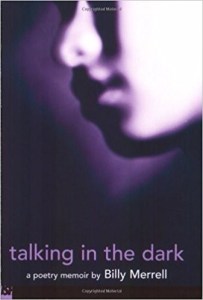
 After getting the chance to be an audience to Billy Merrell at a previous Elan Alumni reading as well as seeing him at Writer’s Fest in 2016, I’m excited to see what he brings to the table at this year’s Writer’s Fest. Reading through his poems have been an emotional experience, but one that I’ve enjoyed greatly.
It takes a level of vulnerability and acceptance towards opening up to be able to write intimately and personally. This is something that took me three years at Douglas Anderson to finally do, but it was a freeing feeling once I finally opened up. I got the same feeling from reading Billy Merrell’s “Canon,” a poem I felt I had some secret connection to through my existence as a writer, as someone who looks onto the work of others in order to give myself the ability and the might to write on my own. I admire the way Merrell not only brings this connection into the piece but makes it specifically personal to himself through the listing of specific poets.
Another admirable aspect of the poem is its beginning, the very conversational tone it takes on from the start. I think much of this comes with the topic of the poem and how open it is to different types of readers to connect. The topic of the poem, self-acceptance, makes the conversational tone seem intimate. There’s an emotional understanding between speaker and reader.
I really enjoy reading poems saturated with emotions and experiences that feel very personal to the writer or the speaker themselves. That’s what it was like when reading “Cannon,” a saturation. I felt discomforted in the best way possible.
Another powerful poem by Merrell is “Folding Sheets,” from his collection Talking in the Dark. This poem describes the moment between a mother and son in which they carry out an everyday action like holding sheets together, but the closeness that comes with doing so. I’ve recently written a lot of poems concerning the relationship I have with my own parents, so this one caught my attention.
This poem focuses specifically on a single moment. It’s layered with many different images, the same object and action shown in different ways, symbolizing different things. I love that Merrell does this, that he makes this moment so vivid that I picture myself there. One line that stuck out to me the most is “And then the air underneath is undone/like hands just after a prayer.” This line, beautifully unique, felt like a breath of air. This moment feels very traditional and devotional. It shows the love between a mother and her son, how much it can be appreciated through such a simple thing.
Knowing that Billy Merrell comes from Douglas Anderson, that he returns to share the art he has continued to produce with much vigor and talent, is inspiring. It strikes down the fear of losing this passion after leaving a sanctuary such as DA. I look forward to being immersed in the art with all the writers next month.
–Kinley Dozier, Senior Managing Editor
 My first year in a creative-writing intensive program came as a shock in many, many ways. Not least was the pure amount of writing we were instructed to complete, the way each piece came with specific mentions of goals, elements, techniques were were supposed to understand. I had been writing for as long as I could remember, but always sporadically, always on my own schedule. I liked the idea of novels, and I tried to expand and expand my characters, ideas, settings. I had no idea how to write towards an intent, and especially not how to apply craft, to revise my piece and actually improve it. Writing shifted from a hobby to a confusing obligation, and, finally, a boring chore. Craft still seemed like a total mystery to me. I couldn’t understand how characters, plot, syntax, or theme worked, so I hated tinkering around with my words. My love of writing had fizzled away.
 It was sophomore year of high school and it happened like this, I’m pouring poetry from my fingertips, filling my journal with more ideas than I can keep up with and then nothing. It just stops and suddenly it becomes painful to pick up my pen. It was the hardest year of my life, I called it “writers block” because I didn’t really know what else it could’ve been. But when the months slipped by and the motivation was still lost to me, I had the revelation that maybe the passion was gone. It seemed as though I was stuck in a pivoting black hole, not sure what I supposed to do from here and I was scared. I don’t think I’d ever been so scared. Six years of dedication wasted on something that was just going to leave without a trace, like a bad ex-boyfriend. The one you tell your grandkids about.
 elanlitmag.org