
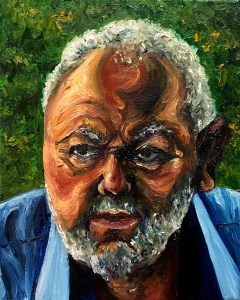
 Emma Flaire’s piece, Henry presents a depiction of an aging man with a sense of dignified wisdom and resolve. The man, presumably named Henry, is depicted with an intimacy that of which could only be derived from a knowledge so innate with detail and history as one in the immediate, is presented to us with poise and respect-demanding form. The piece’s composition draws into the folds of flesh that composes the countenance of the subject. These ridges and caverns carved into his face are not ones of disfigurement, but of vulcanized character. The galvanization of age is shown upon the rendition of a man at ease. The oils of piece accentuate age, and the dynamism of the face’s natural contours ebb toward a culmination of character evident upon the gaze emanating from the piece.
As a writer, I am drawn to the subject of the piece itself. I used this piece, and another submitted by Emma Flaire in a generative exercise based of derivative origin in my own productions. I found my impression of reserved platitude, and the implication of a lifetime of labor to be of great potential for exploration. I focused, in my generative ventures, on the way the piece evoked a sense of demand for respect. The man in the piece gazes with authority at whatever meets his weathered gaze. I wrote extensively on the concept of virtue in labor and the continuance of genealogy through reproductive propagation. I find Emma Flaire to be adept at observing the qualities of an entire man, and the depiction of earnest and comprehensive depictions of the authentic.
I encourage those viewing the piece to look within at their own reservations and associations with that of which they derive parallels from the work of Emma Flaire. Once I was able to divorce myself from the physical limitations of the medium of the visual, and look to find the memories and values within the gaze of this man, and other works alongside it, I was able to articulate and expand upon that which might not have been acknowledged without the assistance of a visual catalyst by which to direct my inner evaluation of those individualistic abstractions.
A fantastic generative process by which I, and others have the potential to realize, is the disassembly of impressionistic conclusions as to the nature of the subject depicted in the piece, and the delving into the components of the derivative implication. The way the artist investigates the formlessness of Henry, and the sheer emotional intimacy evident in the care and detail put into constructing such a nuanced and specifically degraded face is the visual actualization of a memory, formulated from the impressions of a series of presumed interactions. She is, in a sense, immortalizing the impact the subject has on her through her close inspection of that which is common, and therefore making it evidence of a much greater understanding of universality in common interaction.
Emma Flaire’s interpretation of this impression is evident in her apparent dismemberment of her memory’s account, and restructure of a far more connection inviting representation of a stranger, whose intricacies are plainly and eloquently given to us through his face’s austere gaze.
– Sheldon White, Junior Fiction/CNF Editor
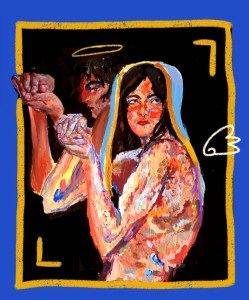 This year’s fall edition of Élan is something that I’m really proud of. This was my first time being a part of the editorial process as the senior Fiction/CNF editor and it was a really cool experience to play a big part in what pieces go into the book. Reading all the pieces that had been submitted and looking at the art was so interesting, as it always is. I think each piece is truly special in its own way, and each one impacted me differently. Two pieces that inspire me a lot are the CNF piece “Jew-ish” by Jake Shafran and the art piece The Whore, The Gunslinger, and the Guy Who Wrote Their Scripts by Nur Chodry. Both of these pieces stuck out to me in the editorial process and I am so happy that they are in the book.
 I am constantly amazed looking at the submissions Élan gets for both art and writing. There are so many talented teens in our community that I am glad they have found Élan as an outlet to make their voices heard. With every book every Élan member takes part in choosing the writing and art pieces that will be in the final look of the book that we create, no matter if it is an online or print edition. My favorite part is being able to read all of the writing and art before the list of both are narrowed down. This is my favorite part because it allows me to dive in to someone else’s world for a second and see what is going on in their mind.
 elanlitmag.org