
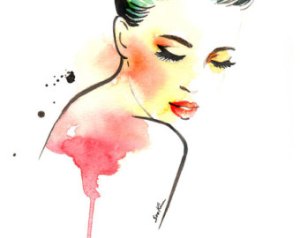
Of all the beautiful artwork published in Élan, the piece that resonated that most with me is probably Slow as Molasses by Isabella Gardner. Not only are the aesthetics of this piece incredible, but the different meanings that could be behind it, how it connects to the pieces on either side of it, and how it connects to Élan as a whole are all amazing.
How this piece looks visually on the page is both intense and beautiful. While it’s drawn completely in black and white, the contrasts between the woman, the wall behind her, the bee, and the molasses dripping from her head allows for a lot of interpretation about light and color, even without those being present in the piece. The details of the woman’s lips and eyes allow for a lot of interpretation about what’s happening in the work; while the bees, which are often seen as symbol for discovering personal power, and the woman’s facial expression, which looks somewhere between self-discovery and pain, she’s also drowning in molasses, something incredibly sweet. Despite bees having stingers, the woman looks as though she’s being awakened as she’s being drowned and stung, and despite its ambiguity, the piece allows for a lot of personal interpretation. I personally see the work as a representation of how we often drown in our own vices and pleasures.
The piece also pairs incredibly effectively with the pieces around it. Altar Serving by Jaclyn Berry explores a girl finding pleasure in a time of intense emotional pain and stress, and Recipe for Baked Potato by Noland Blain explores themes of suffocation and the painful, unhealthy aspects of something delicious. As well as being one of the most thoughtful and beautiful pieces we’ve ever published, I think part of the reason it stands out in my mind is how it complements the writing and brings out themes in all three of the pieces that may not have been clear without the pairing
I also feel as though this piece epitomizes the message of Élan. We try to select pieces for our books that we feel are not only thoughtful and aesthetically pleasing, but also pieces that invoke an emotional reaction in the reader and that explores themes deeper than what’s merely on the surface. This piece allows for a vast amount of interpretations, is beautiful on the page, and totally fits in with the theme of the entire spring 2017 edition.
– Oona Roberts, Senior Layout and Design Editor
 As the Junior Art Editor of the Fall 2017 issue of Élan, one of the pieces I reviewed that resonated with me the most would be “Wind Up Boy”. Stylistically, one can see how it can catch a viewer’s gaze. The artist very masterfully creates a face for the portrayed character, immediately drawing attention to the rest of the piece and its meaning. The color scheme and the position of the boy also work to add a layer of depth to the message. To fully understand the striking aspects that the artist is able to convey in this piece, it must simply be seen through its original medium, as I do not believe a recreation of it through words will be able to truly illustrate its traits.
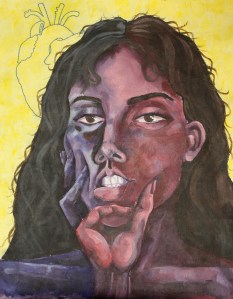 Being a writer, I am always looking for a sort of inspiration and depth; images that delve into the mind and explore the deepest desires within us all. This is exactly the reason I chose the piece Blank by Jasmine Hernandez as my favorite art piece. Not only does Blank split the idea of love open under a microscope, but the artist uses contrasting colors and vivid detail to engage the reader and tell a story no one else can. In it, I see the idea of human connection. The heart, which has always seemed to embody the emotions hiding within us, is in the exterior bringing into question a subtle battle between external and internal that I am too familiar with as a writer.
 elanlitmag.org