
 Two bodies pressing against one another, grabbing hold of their clothes, and resting their heads together. This painting’s background is screaming with colors: pink, white, purple, yellow, green, blue, and brown. At first glance, I thought this piece was possibly a Madonna and child painting. The elegance of the woman, her eyes steadily watching me, felt like a raw declaration of something. The second person, their face covered with a drape as if they service a bigger purpose than to show facial expressions, is clinging to the woman. The closer I looked the less it became about mother and child, and more about intimacy. Élan editions are about intimacy with writing and art.
The vibrant lines of color are formed into straight lines, bar almost, and with only two holding back the people in the painting by their shoulders. The lines could’ve gone through their faces, or their necks, but the fact that they overlap their shoulders feels protective. I think of being captivated, blocked by something else. I’m a believer that sometimes not writing can leave a person blocked, but reading can trap someone in another word. Sometimes when I read poetry I don’t even feel like a human being, I don’t realize my brain is processing literature or that I’m reading the words right off of someone else’s thoughts. I think sometimes we forget that when we read someone else’s work – poetry or fiction or nonfiction – and look at someone’s visual art, we are literally peering into someone else’s heart and I think that’s beautiful.
The woman’s body, who I originally believed was a version of the Madonna, is full of swirls. Her twists and spirals even inch onto her wardrobe, continuing in her hair and under her chin. The person hidden next to her has no swirls. She’s painted with splashes of paint, bright and almost angry looking and it makes me think that perhaps her love is not only blind but raw too – hence the title piece Young Love. This person, blinded by the blue drapes, is also another shade of the clothing they wear. Maybe this is a stretch but the blues could symbolize love can feel blue sometimes – the blindness of love affairs.
Pieces that make me think are my favorite and just looking at the painting for one minute made me think of so many different intents. Are they being held back by love? Is the theme intimacy or sorrow? What are the woman’s eyes saying? Are they hugging each other or not? Just like the written pieces in each Élan edition, the artwork is also chosen with the intent of intimating the minds of our readers and pushing them to want to understand. To me, Élan means engaging the brain and this single art piece did that for me. This piece represents Élan with its colors and endless possibilities of interpretation. It invokes my interest just like each art piece in this book.
– Valerie Busto, Creative Non-Fiction/Fiction Editor
 Whenever I feel like I have come to a point where I have “run out” of things, ideas, themes, I turn to visual art to try and find inspiration. I do this thing where I am constantly writing about myself and what is happening in my life and, in turn, feel as if I am continuously writing about the same things over and over again in the same exact ways with the same exact language. It feels like I am stuck in my own writing.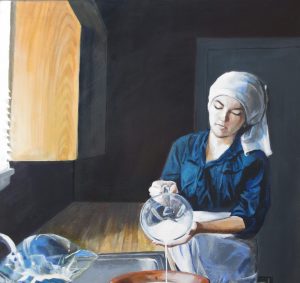
 elanlitmag.org