Black Voice

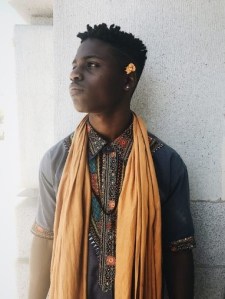
From first glance, Jamal Parker is a very successful young writer. He has been champion to a number of poetry slams, worked as an editor in different publications, and is a Douglas Anderson graduate. A lot of his work, written and in the literary community, involves speaking through the perspective of being a Black man and pushing the achievements of Black people. I personally connect to this aspect of Parker as a writer, as I too often write about the being Black and what the Black experience is to me. Parker has judged for a poetry competition for the Campaign of Black Male Achievements and is a member of the Black Boy Fly collective, an artistic performance team.

Just from reading the titles of Parker’s voice, I get a feeling that he is an unapologetic voice who is more than willing to ask questions and interrogate to get the answers. As I read his poem “and in this nightmare a white supremacist tried to kill me,” I felt tension throughout the entire piece. It felt like straining, like not knowing what was going to happen, falling apart because of it, then coming to an open end, still unknowing, yet learned. A technique Parker uses is imagery. The last lines (“his intentions are as bold as burnt crosses on Sabbath morning”) are stunning. This image is very strong on its own. Although the poem is full of tension, this image is the most packed and uses masterful language.

Continuing to search through Parker’s poetry, I noticed he often ends his poems on assertions. Poems are very short and compact. It begins, develops, and concludes a story usually in a small number of lines. This can make poetry harder to chew as it is so much in so little time. Sometimes a poem needs to cram, to set things against each other in a tight space to create friction. I believe Parker is very efficient at giving just the right amount when it is needed. He explains the contents of his poem then crafts an assertion at the very end to get that right amount of direct and compact. This plays out in his poem “Last Monday.” In this poem, Parker describes what it’s like to be a Black student in a classroom of ignorance. Throughout, he shows his feelings of injustice and anger through short language and tone in lines like “like my brothers and I aren’t soon to be buried there” and “like she’s chewed on the word before.” He ends “College is where I discovered, being an activist in a classroom setting is actually holding my mouth quiet—” which speaks to the frustration the speaker is feeling, the final assertion, external and internal anger.

What makes Jamal Parker a masterful writer to me is his need to dive into personal experience. His work is full of clear voice and emotion that show how unafraid he is to show himself through writing.

Lindsay Yarn, Digital Media Editor

Saturation

After getting the chance to be an audience to Billy Merrell at a previous Elan Alumni reading as well as seeing him at Writer’s Fest in 2016, I’m excited to see what he brings to the table at this year’s Writer’s Fest. Reading through his poems have been an emotional experience, but one that I’ve enjoyed greatly.

It takes a level of vulnerability and acceptance towards opening up to be able to write intimately and personally. This is something that took me three years at Douglas Anderson to finally do, but it was a freeing feeling once I finally opened up. I got the same feeling from reading Billy Merrell’s “Canon,” a poem I felt I had some secret connection to through my existence as a writer, as someone who looks onto the work of others in order to give myself the ability and the might to write on my own. I admire the way Merrell not only brings this connection into the piece but makes it specifically personal to himself through the listing of specific poets.

Another admirable aspect of the poem is its beginning, the very conversational tone it takes on from the start. I think much of this comes with the topic of the poem and how open it is to different types of readers to connect. The topic of the poem, self-acceptance, makes the conversational tone seem intimate. There’s an emotional understanding between speaker and reader.

I really enjoy reading poems saturated with emotions and experiences that feel very personal to the writer or the speaker themselves. That’s what it was like when reading “Cannon,” a saturation. I felt discomforted in the best way possible.

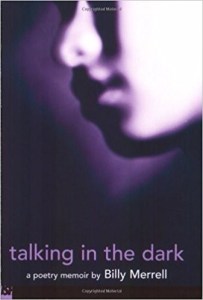
Another powerful poem by Merrell is “Folding Sheets,” from his collection Talking in the Dark. This poem describes the moment between a mother and son in which they carry out an everyday action like holding sheets together, but the closeness that comes with doing so. I’ve recently written a lot of poems concerning the relationship I have with my own parents, so this one caught my attention.

This poem focuses specifically on a single moment. It’s layered with many different images, the same object and action shown in different ways, symbolizing different things. I love that Merrell does this, that he makes this moment so vivid that I picture myself there. One line that stuck out to me the most is “And then the air underneath is undone/like hands just after a prayer.” This line, beautifully unique, felt like a breath of air. This moment feels very traditional and devotional. It shows the love between a mother and her son, how much it can be appreciated through such a simple thing.

Knowing that Billy Merrell comes from Douglas Anderson, that he returns to share the art he has continued to produce with much vigor and talent, is inspiring. It strikes down the fear of losing this passion after leaving a sanctuary such as DA. I look forward to being immersed in the art with all the writers next month.

Kinley Dozier, Senior Managing Editor

What It Means To Be an Artist

My biggest fear is waking up on a Monday morning, with warm sunlight seeping in through my paneled window, the sound of birdsongs coming in through the ventilation and realizing that someone that I love or have loved, is gone. The idea of that imaged latches onto my insides with bird claws and doesn’t let go until I find something to distract myself with. That’s where Kieona Wallace’s “Return Date: 5/11/1974” really hit me. With her sour story on a man who returns home from war, different than from when he left and the aftermath of the different feelings his wife has to go through. This is the  type of story that forces me into perspective of my own fears. The main character didn’t lose him, but at the same time she did and I can’t seem to wrap my head around how you’re supposed to cope with that. It reminds me of holographic figure. The person is there, they look the same, they sound the same but the smell is gone. The smile has dimmed and there’s something in the person’s eyes that make you uneasy.

Those are the type of stories that make Elan what it is. The ones that dig down into your core and bring something out of you, something that you can grasp onto and look at with wholesome eyes. The type of artwork and writing that makes you lose your breathe and take a step back wondering how someone so young could do so much. Without literary magazines like Elan, people would still be stuck in a idiotic whirlpool mindset that you have to a certain age to produce something as fantastic as Kieona did. People like to blame things one experience. My grandpa in particular preaches on a day to day basis that I can’t know anything about the world because I’m not old enough. He, as do many others, believe that unless I’ve lived for fifty years I’ll always be shallow and naive. Elan proves people like him wrong. You can’t sit down and write about things like this unless you know.

What people like my grandfather fail to realize is just because I haven’t been through a divorce, doesn’t mean I don’t know what heartbreak feels like. I learned that when at the age of two when my parents never came back. Or that because I don’t pay mortgage, I don’t know how to be responsible. I learned that age the age of twelve when my grandmother was getting to overwhelmed to raise a 9th kid. I’m seventeen and me, along with almost everyone else in my generation have more through more crap in one year than most people go through in their entire lifetime. Elan allows people to display that, it allows for all of those talented artists being shooed away into a closet to step out and show everyone what it means to be a writer. What it means to be an artist.

Sierra Lunsford, Website Editor