
 I’ve never been good at keeping things short and sweet. As a person who rambles in their writing, who takes a long time to say what they need to say, I deeply appreciate poets who master brevity. I immediately felt this admiration towards Gwyneth Atkinson after reading “Sleepwalking” in our Fall 2018 edition. Her piece has inspired me tremendously.
From a structural perspective, the poem is only comprised of twelve lines–each line no longer than ten words in length. Yet the content of the piece is so intimate and emotionally charged that the word count becomes irrelevant. In fact, it is strengthened by the fact that it takes up so few words on the page.
My favorite line is the poem’s first line: “I woke up this morning having dreamt of my mother.” There is so much implication! We don’t have to be explicitly told whether the dream was bad, or whether the dream was good. Or what even happened in the dream at all. We, as readers, can just tell that it was haunting enough to wake her up. And the rest of the poem parallels this structure of implying and not telling so beautifully…it greatly matches the piece.
For me, writing about my mother falls into a steady rhythm of sameness. I write about the same couple of events, the same couple of feelings, draw the same conclusions in the end. Reading this poem was a realization for me. You don’t have to tell the reader everything! In fact, Gwyneth says the word “maybe” three times in her piece. When writing a poem, you, the poet, don’t even have to know what you’re writing about! Allow the reader space to read, to think about what you’re saying…you don’t have to force-feed a message.
I’ve been trying to find other lines of the poem to quote, but I find myself wanting to excerpt the entire latter half: “Maybe, last night I crossed fields/ Of black grass and cow shit to step/ Into her room, to sit with her, my eyes moving/ Under my eyelids like animals./ Maybe she woke up having dreamt of me.” There is so much longing here. I was left thinking about my own mother: how parts of me still want to be with her, and how much I wish she wanted to be with me.
This is the haunting “Sleepwalking” embodies. We don’t know the speaker’s relationship with her mother. We know she is hurt. Her words sound like the most private confession; an almost guilty admittance. It doesn’t take a ton of words to be honest– it takes guts. In this piece, we know what the deepest and most subconscious part of she wants. And that is truly the most meaningful thing I can ask of a poet.
– Olivia Meiller, Junior Editor in Chief
 At the start of my freshman year of high school, I did not know how to write. I knew that I wanted to write, and I knew that I had a lot to say, but I hadn’t quite figured out how to articulate any of it. The poem that changed all of that for me was “Killing Flies” by Michael Dickman. I stumbled upon it by chance, and I was immediately captivated. The opening lines grabbed me and pulled me into a situation that I had never come close to experiencing, but that I somehow felt incredibly connected to
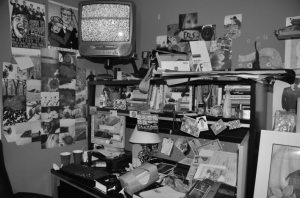 This piece, for me specifically reminds me of how much of a mess things can be, but still have beauty in it. There are so many object places on desk, the floor, and the sides, and for some reason I find comfort to that. The picture in general, seeps creativity. There is no emotion to evoke in the art because that’s not the point that it’s trying to prove. The point is that it’s trying to show the life of an art student. As I was looking through the book, there were so many pieces that we great don’t get me wrong; however, the fact that there was so much going on in the piece, it was also in black and white. It could’ve been colorful, which would have made every object illuminate more, but it wasn’t. And that’s what is so great about it. I always find myself attracted to blank things in general, because I know there is more to it. I also picture life as in that way, so I think that’s why is resonates so much for me. This desk has paintbrushes, paintings, books, paint, etc. Instead of it being an organized desk, no, no it’s an art student’s desk. That leads to how it represents Élan. As a writer, I myself like to messy, but only because it sparks for something for me. If everything was so clean and cut, you do not have a lot to work with it. That’s how Élan is. Élan works with the strangest writing pieces and art pieces, and that’s what makes us so unique. The community grows off of creativity
 elanlitmag.org