
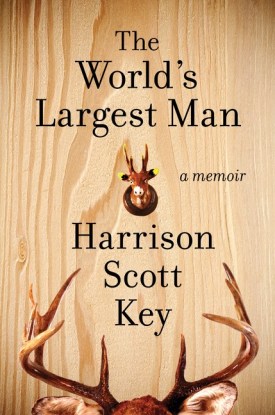
 Key is excellent at producing a smile or one of those laughs that slip out unexpectedly. His work has that quality to it that grandparents, or an older relative contains in which you want to know everything about their words and their stories, and that essence is especially strong in his memoir: The World’s Largest Man.
Within his memoir, Key recalls growing up with family from the Mississippi and breathing in Memphis—and all the unusual characters that make up his life. He shows us his “questionable” family make-up and his ponderings regarding if the universe had gotten everything wrong and he actually belonged to a different family. It’s relatable, yet the fictional progression of the story leaves you yearning to know about Key’s particular set of circumstances. Creative nonfiction is an overlooked medium of writing, though Key has made me appreciate the form again. I’ve recently gone back to my fiction roots, and I’m learning new elements to the craft and I adore how much of it is intertwined in Key’s work.
I knew that creative non-fiction and memoirs could be compelling when done right, and Key has me itching to write some of my own childhood memories and left me wondering what’s going to happen in my future that I can painfully and comically write down. I only was able to read excerpts of The World’s Greatest Man and I’m completely surprised at how it has changed my perspective and sparked an interest in type of writing I thought I didn’t need.
That’s what writing is supposed to do though. I constantly forget that the written word can change your perspective which is something funny and “shocking” to say, considering I am a well, writer. But I think that when I do have these realizations I’m once again amazed and I fall in love with writing and I can be in awe of its magnitude.
I am so happy I got to experience, even if just a taste, of Key’s work. The diction itself is enough to keep one compelled. There’s a bluntness in the words, as well as a child like wish to know more tangled in with that slight dissatisfaction and fondness of life. It’s complex, even within the first few pages. The specificity of the details drive the memoir forward, as if Key was trying to grasp every piece of his memories to make them as cohesive and beautiful as possible. I think that I also try to achieve a similar voice within my own work as Key and that’s what drew me in deeper to his own story.
Even into the acknowledgments page, the voice there is in ways who I saw before and very, truthful, and it’s poetic too. I think in our heads, there are specific genres and it’s hard to see the elements of others mixed up in it but it makes me so happy I perused writing because it’s a constantly discovery playground.
Key has the wit and cleverness to make anyone turn up the corners of their mouth, it’s bound to happen and it cannot be denied and it’s so perfect to know that in every way that someone can still do that to you when you’re wrapped up in the mundane aspects of life.
-Kiara Ivey, Junior Layout Editor
 In light of the Douglas Anderson Writer’s Festival approaching within the next month, I decided to take time to get to know some of the featured authors before working with them. Janice Eidus in particular stood out to me. She specializes in fiction, but has also written essays. In The Wanderer, an essay published in the New York Times that deeply explores the directions her life has gone up until now, she illustrates how shifts in her environment from her youth into adulthood fluidly, unraveled the milestones in her life and sparked endless imagination of her future, which continued beyond the end of the essay, off the page—as all of our stories do. Even before plunging alongside her into this moving world of crumbling staircases, alcoves, and music on rooftops, when I felt I knew her at least on the surface as an “honorary Jewish Puertorriqueña,” I found her fascinating. She was raised in the Gun Hill projects of the northeast Bronx, where she and her friends devoted themselves to the promise of an education, as well as the toughness of the streets. After college, she sought the Bohemian lifestyle which would infatuate her for years to come.
 One writer of Douglas Anderson Writers’ Festival 2016 who I cannot wait to meet is Harrison Scott Key. He has been published in an array of magazines, my personal favorite being McSweeney’s, and writes about what often feels like personal memories through a view of both nostalgia and hilarity. When studying hardcore literature, it is easy to forget the value of humor writing. Key’s work brings both literary value and laughs into the same world. For example, his piece “Fifty Shades of Greyhound” depicts the unsightly experience of riding a bus across the states in a way that is both creatively descriptive and hilarious. An example of this blend can be found in the following line:
 elanlitmag.org