
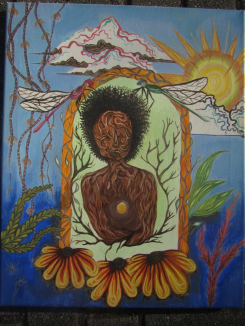
 An art piece from an edition of Elan that has stuck with me is “Untitled” by Janai Dawkins in the Fall 2016 Online Edition. Personally, I like very abstract art, something that makes me look more than once and all around to try to figure out just what’s going on. This piece, although it’s abstract, has a focuses center, a distorted figure. Calling it focused and distorted is a contradiction, but I think that’s just what the art piece is trying to accomplish. The dark, swirled figure is set against a bright and active background, colored blue with the sun packed into the corner, greens and flowers decorating the frame that encases the figure. It’s really up to the observer what the piece means, to answer the questions that the art raises.
Questions I asked when first seeing this image were: who is the figure? Why are they framed? Where are they? Why are they distorted? These are all questions I could pose and answer in my writing. I see writing and art as cousins. I think art is one of the best stepping off points from the creation of a written piece. For me, I like to write poetry from art. The term for this kind of poetry is ekphrastic. Poetry is a snapshot of emotion. This can be said for art as well. Art is still, yet full of movement. It is a moment paused to be examined and understood by the viewer, just as poetry is meant for the reader to take in. Taking these aspects and making them meet creates an even more extensive impact.
One of the most important things in Elan is the making of powerful, creative work. All the work displayed is meant to encapsulate the reader/viewer and bring them out with their own takeaway from the pieces. This is a goal of Elan. The art and writing in each issue come together to create a deeper meaning, to get across the importance of art forms that come out on the page.
Lindsay Yarn, Digital Media Editor
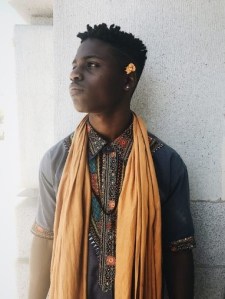 From first glance, Jamal Parker is a very successful young writer. He has been champion to a number of poetry slams, worked as an editor in different publications, and is a Douglas Anderson graduate. A lot of his work, written and in the literary community, involves speaking through the perspective of being a Black man and pushing the achievements of Black people. I personally connect to this aspect of Parker as a writer, as I too often write about the being Black and what the Black experience is to me. Parker has judged for a poetry competition for the Campaign of Black Male Achievements and is a member of the Black Boy Fly collective, an artistic performance team.
 As artists, we all reach stages in our writing where we feel like our work is the worst we’ve ever created. We put our hearts and souls into personal pieces only to find the harshest criticism comes from ourselves. This doesn’t only happen to famous authors, it happens to all writers. As human beings, our confidence is like grains of sand; it slips between our fingers and completely leaves before we even know it.
 elanlitmag.org