Creative Nonfiction

I’m drawn to a certain style of writing that only specific genres can bring. Of course I love to curl up next to a fire scented candle in the winter and read a good fiction story. But fiction doesn’t have the honesty that I strive for when I read poetry. And Poetry, loaded with ambiguous language, can send my mind into another galaxy. So I look for one of my favorite genres, creative nonfiction. It is probably one of the most over looked and underrepresented genres in writing but it is a mix of truth, honest, imagery, and figurative language that connects like no other genre.

People neglect that Truman Capote’s In Cold Blood is actually a creative nonfiction story. Under the lingering coarse details of a family murdered in Kansas, there is a pile of truth that no other fiction story or poem could reach, though creative nonfiction doesn’t have to be that dark. David Sedaris has written many essays and even published a book titled Me Talk Pretty One Day exploring his move from New York to Paris with a satirical witty approach. These writers both take either their own or other’s trials and tribulations in life load it with thought provoking and striking scenes before feeding it to readers.

-Chrissy Thelemann, Submissions Editor 

The Fictionality of Poetry

Grace 1As the poetry editor I don’t focus a lot on fiction. In fact, I stay far away from it. I like to stay in my little poetry bubble with metaphors and ambiguity. Recently I have been having trouble in my personal writing. I’ve been trying to write poems with stories too complex for their lines. Believe me I tried narrative poetry and it didn’t work. I had hit a creative road block all because I was stuck on a form.

The simple fact is that some ideas aren’t meant to be poems. Some stories are meant to be told in prose or in novels. A while ago I told myself I was a poet and restricted myself to just writing poetry. At the time I didn’t realize that language cannot be restricted to one form. Language talks back. Language will tell you when it doesn’t like what it is. During second reads I read fiction pieces. While reading the stories I realized that maybe some of my poems were meant to be something else. So I decided to go on a journey with my language. I sat down with my poetry and asked it what it wanted to be. Some said poems and others said that they were fiction.

The only thing I could do in the situation was comply with my pieces. Nothing is worse than making your pieces be what they don’t want to be. All it does is result in a lot of hair pulling and unhappiness. Through the process of reworking my pieces I started to appreciate fiction more. Fiction has a lot of the same techniques as poetry. Fiction is just poetry with a lot more characters and a more complex plot. I found that fiction isn’t all that bad and I stopped being scared of it. I found that language is its own beast and I shouldn’t try to tame it.

-Grace Green, Poetry Editor

All you need is prose! (and poetry)

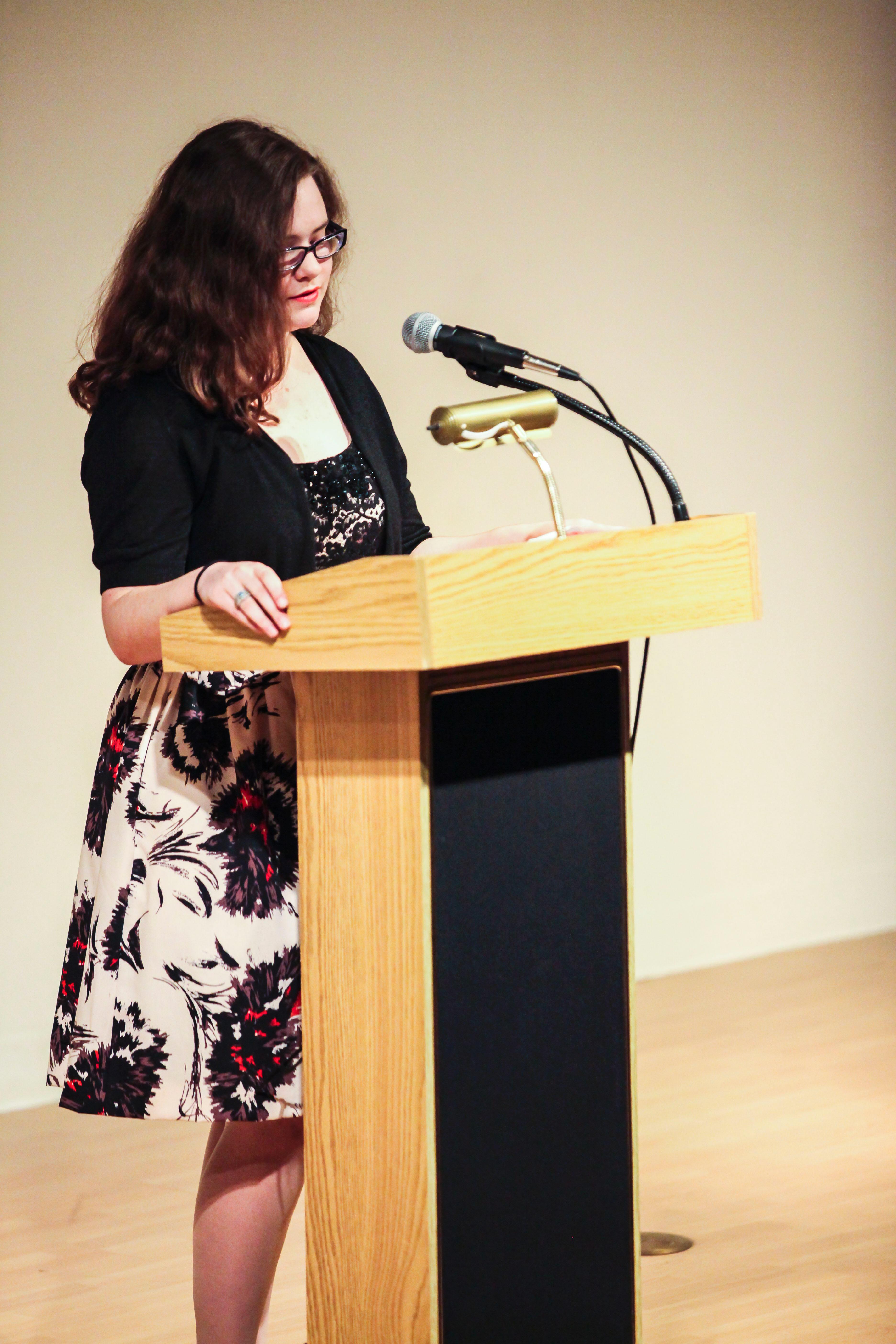
Senior Reading at the Museum of Contemporary Arts, Jacksonville.

Sarah Buckman at the Senior Public Reading. Hosted by the Museum of Contemporary Arts, Jacksonville.

Right now, I am in poetry mode. In school (and at home), I am still writing poetry about weather and what people have lost, and to be honest, it can be really hard to translate that into “fiction mode.” It’s harder than it seems to switch from line breaks and meaningful pauses to paragraphs and key words. But the key to doing anything is practice. My advice would be to write prose poetry if you are having trouble connecting back to fiction. A prose poem is a poem in all aspects, except it looks exactly like a prose piece. This can be very helpful, as the form of the poem can help stir your mind about “past fictional experiences.” Sometimes just seeing a poem in the form of fiction can help to move that block in your head that’s screaming “Poetry, give me Poetry!” This is a really effective way to change your view on prose. You can still use some poetic technique in fiction. Imagery? That is what keeps fiction going, and don’t even get me started on characterization. Another method to get into fiction mode: read fiction. It sounds simple and it is! Anyone who wants to be better in their craft should read what the professionals write. It just makes sense to read a piece by one of the masters if you want to be a master one day too. So go out and read some fiction. Search a topic that interests you and find a piece that is about that topic. Or find your favorite fiction writer and read their work. What you want to do is immerse yourself in what you are writing. If you always have trouble with plot in your fiction writing, read an author who has great plot technique. By immersing yourself in the classics, you will find your writing getting better over time. So to review, write some prose poetry to help your brain get into the fiction mindset, and read fiction! Once you immerse yourself in the world of fiction, you may just find it hard to leave!

– Sarah Buckman, Editor-in-chief