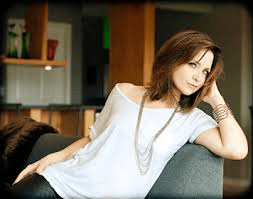
Teri Grimm

Teri Grimm is a local writer, residing in Jacksonville, Florida, with her family. She received her BFA in poetry at the University of Omaha and her MFA at Vermont College. Grimm has two collections of poetry published as well as having her writing appear in other literary magazines, journals, and anthologies.

Personally, I was not all too acquainted with her writing before coming to Douglas Anderson and being introduced to her by the writing teachers. From the get go, the fact that she was a local writer made her more accessible to me because she was here in my town. She didn’t live in New York City or Chicago or in a remote cabin in the woods; she is where I am.

Out of the poems that I have read of hers, the one that has continued to stick with me is Magic Lantern. The progression of her images is so natural and the language is attainable. I don’t like to read poems where the language is so over my head that I don’t know what on earth is going on because it takes away any connection that I could have made with the work and the speaker of the poem itself. Grimm’s language allows for me delve into the poem itself.

Magic Lantern, specifically, poses philosophical ideas and questions of identity and the significance of life, but not in the way that is too overwhelming. The images themselves are grounded, so that the poem isn’t this abstract piece that I couldn’t grasp onto. Images like “he’d show glass slides of the Taj Mahal / or lovers kissing in a Venetian gondola. Familiar / scenes too and after flickering black and grey.” These are some of my favorite lines from this poem solely because I can see what the speaker is talking about. I can feel the awe of the Taj Mahal and I can feel the romance of the lovers kissing in a gondola. I am with the speaker.

How she ends this poem is what stayed with me the most. The poem is structured as a single longer stanza with long lines and then the ending line is on its own and is shorter than the rest. “But that was before I knew better.” Through the latter half of the poem, Grimm explores ideas of being this almost ethereal person and having this kind of light to her, so that “the world could see me better.” The language, again, is beautiful and captivating in itself, but the last line is what got me. It switches the speaker’s tone into something more reluctant and questioning of the world and themselves. Before the speaker is hopeful, maybe even a little jovial, but then the last line allows for the speaker to become someone more cautious and scared almost.

Grimm’s writing has allowed for myself to be okay with taking these turns that aren’t entirely expected because typically, I am careful with my writing, I am in my defined comfort zone. But with Grimm, she turns the poem, like all good poets, so that it isn’t what you expect.

Read Magic Lantern here: http://teriyoumansgrimm.com/poems.html

Winne Blay, Junior Managing Editor

Grounding Myself in Art

Whenever I feel like I have come to a point where I have “run out” of things, ideas, themes, I turn to visual art to try and find inspiration. I do this thing where I am constantly writing about myself and what is happening in my life and, in turn, feel as if I am continuously writing about the same things over and over again in the same exact ways with the same exact language. It feels like I am stuck in my own writing.
Going to visual art allows me to disconnect my personal life from my writing and take on the voice of the subject or artist or to interact with something other than myself in my writing. I will write pieces that I would have never thought about writing or even thought of in general because of pulling my inspiration from something else, something intended to make the consumer feel some sort of visceral reaction.

Both writing and visual art make their consumers think and go further into each piece than what is first seen. It’s amazing. I can look at the same piece of art endlessly, but still continue to find something else about the it. There is always more.

Élan takes both art and writing and uses them so that a kind of symbiotic relationship occurs within the book itself. There is writing that has to do with the art and art that has to do with the writing. Each feed off the other.

In the 2017 Fall edition, an art piece titled, Fruit on Wheels III, is one that I find myself going back to consistently and doing nothing more than just looking at it and trying to piece together a semblance of the story of what is happening in it. Who are the two men? What are they doing? Where is it? Why was the artist drawn to capturing this moment in time? What did the artist want people to get out of it?

In all honesty, I am not entirely sure as to why I am drawn to this piece. There’s a story or something deeper lying in every piece of artwork, and I will most likely never truly know what the artist intended to say with this piece, but I can piece together what the art is telling me.

It tells me anguish and hard work and determination and exasperation and aspiration and just-getting-by and this-is-life-and-it-is-okay. I think it is partly because I am who I am and that I write what I write. I don’t do super crazy fiction stories or fantasy or abstract. I do grounded and realistic and in your face and there is more to what I am saying. That’s what I felt from this artwork. On the surface, you understand what is most likely happening, but you keep going further and further into the work itself and the smallest aspect of the art means something.

Writing from this piece would be me removing myself in the sense that maybe it isn’t a personal narrative that I am telling, but instead, someone else’s narrative that I am telling with personal conviction and connection.

Winnie Blay, Junior Managing Editor

Suffocation of Something Beautiful

Of all the beautiful artwork published in Élan, the piece that resonated that most with me is probably Slow as Molasses by Isabella Gardner. Not only are the aesthetics of this piece incredible, but the different meanings that could be behind it, how it connects to the pieces on either side of it, and how it connects to Élan as a whole are all amazing.

How this piece looks visually on the page is both intense and beautiful. While it’s drawn completely in black and white, the contrasts between the woman, the wall behind her, the bee, and the molasses dripping from her head allows for a lot of interpretation about light and color, even without those being present in the piece. The details of the woman’s lips and eyes allow for a lot of interpretation about what’s happening in the work; while the bees, which are often seen as symbol for discovering personal power, and the woman’s facial expression, which looks somewhere between self-discovery and pain, she’s also drowning in molasses, something incredibly sweet. Despite bees having stingers, the woman looks as though she’s being awakened as she’s being drowned and stung, and despite its ambiguity, the piece allows for a lot of personal interpretation. I personally see the work as a representation of how we often drown in our own vices and pleasures.

The piece also pairs incredibly effectively with the pieces around it. Altar Serving by Jaclyn Berry explores a girl finding pleasure in a time of intense emotional pain and stress, and Recipe for Baked Potato by Noland Blain explores themes of suffocation and the painful, unhealthy aspects of something delicious. As well as being one of the most thoughtful and beautiful pieces we’ve ever published, I think part of the reason it stands out in my mind is how it complements the writing and brings out themes in all three of the pieces that may not have been clear without the pairing

I also feel as though this piece epitomizes the message of Élan. We try to select pieces for our books that we feel are not only thoughtful and aesthetically pleasing, but also pieces that invoke an emotional reaction in the reader and that explores themes deeper than what’s merely on the surface. This piece allows for a vast amount of interpretations, is beautiful on the page, and totally fits in with the theme of the entire spring 2017 edition.

Oona Roberts, Senior Layout and Design Editor