
 Since I was young, I knew I wanted to write stories. I would make up elaborate lies, not to get over on someone, but just to capture their interest. When my mother would tell a story, I’d always add, “what if… happened” and she’d say, “you’re such a story teller.” I loved the title “story teller.” The way it gave me permission to come up with scenarios and characters, and to bring life to the page. Being a fiction writer was going to be my one and only task in the writing world, until I read “History Lesson” by Natasha Trethewey. In my freshman year of high school, I chose that poem to orally interpret in Speech class. As I stood in front my peers, hands shaking and knees locking against my teacher’s instructions, I recited the poem. As Trethewey and her grandmother stood on the “for colored” strip of Mississippi beach, I felt connected to her. I felt as if I was Natasha Trethewey, holding that picture forty years later feeling admiration for her grandmother and remorse for her being gone long before she could be considered any type of equal. That is when I knew that I couldn’t just bind myself to fiction.
Natasha Trethewey has a way of putting you into her own shoes, her own clothes, and her own house that stands just behind the railroad tracks in her poem “White Lies.” It is not just because she is writing poetry, which is an ideology that I had to learn. I knew that poetry could be about anything, but the poetry that impacted me the most had been wrought out of personal experience. Consequentially, the poems I wrote were drawn out of my own life and explained in twenty lines or more, both steps I felt I couldn’t take in my fiction writing. I used childhood incidents and teenage curiosities to guide my poetry, thinking that was the only way I could write good poems. Yet, I knew there was something that limited me from being the Natasha Trethewey of my own poetry. A skill that she had that I felt I lacked, and didn’t know if I could gain since I didn’t have the same experiences as her. I initially felt as if I couldn’t write poetry like her because I hadn’t lived through segregation like her. The only south I knew was south Florida, and I thought that was the reason I couldn’t get through this wall I’d built for myself.
The poem “Flounder” tells of a time Natasha and her aunt were fishing. The poem, like most of her poetry, is more complex than a younger Trethewey catching a fish, a feat I’d never accomplished. Yet, that didn’t stop me from understanding the poem and understanding every person and detail in the poem. Poetry isn’t just writing about your experiences. Fiction isn’t just writing about your experiences. Writing as a whole isn’t just writing about your experiences. It is about using your experiences as a guide for your readers to get to the bigger, important message. Trethewey didn’t have to write about her own experiences, she just had to make the reader feel as if that was their experience. She had to make the reader angry about how they were treated. She had to make the reader understand why she felt it was important to write that poem. Natasha Trethewey uses details so specific to build images so vivid, that we want to relate to her poetry and we do.
I haven’t given up on fiction, nor have I stopped using my own personal experiences in poetry. In fact, I’ve mixed the two and gotten something that I think my younger self would be proud to read. I have poured my personal experiences into my fiction, letting them fill out characters and plots in a way that lets the reader relate and become the characters or narrator without even having to experience the situations for themselves. I learned that writing is not telling your experiences or made up experiences and hoping the reader is interested enough to continue reading. Writing is using your own experiences and maybe those of others and allowing the reader to understand and relate to the complexities through your detail and effort at trying to tell your story the right way.
-Chelsea Ashley, Digital Communications
 I have a thing for deeply flawed voices in stories. Those characters who immediately rope you into a new way of seeing the world. Use of diction and sentence structure is crucial to sending the reader straight into a character’s head. There are many great examples, but no one author has influenced my way of composing sentences like George Saunders.
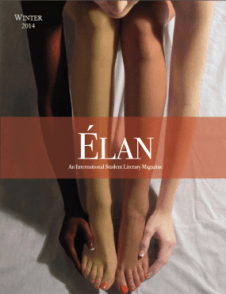 I’ve had the opportunity of being on the Élan staff for two years, and I’ve witnessed a dramatic evolution within that short time. This is probably due to the fact that I’ve had two different editorial roles within the staff. I started as Fiction Editor last year, and became Web Editor this year. The two exist in completely separate spheres, but they come together to produce the same result; the print book that showcases our yearlong dedication and the unique work of young writers everywhere.
 elanlitmag.org