
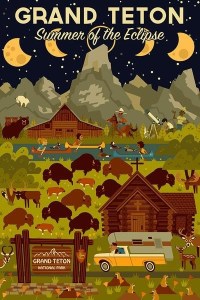
 Recently published in the Fall 2017 edition was “Crossings”, a story by Douglas Anderson writer Rafael Pursley. This whole edition, in particular, had a number of pieces which struck me deeply for their power in creating and enlivening images, bridging an emotional gap between the natural world around the more interior, personal conflicts. As an artist with a passion for science, particularly environmental and natural disciplines, I was thrilled to see such pieces filter through our reading process. “Crossings”, in particular, manages to sum up the distance, the closeness, the power of the natural world on our human lives often deemed entirely separate.
The range of imagery struck me from the first time I read “Crossings”. It has one of those near-perfect balances of the gritty, nasty and all too real of a mucky wood pond, but also the ethereal, the breathtaking of a solar eclipse. As someone who is constantly trying to fit her all-consuming connection to the natural world into her writing, I found the accuracy of these images exciting. It can be so difficult to represent both the beauty and the obnoxious about nature in writing. The story didn’t just use physical description, however, it fit the adjusting landscape into the conflict of the story. This was one of the most impressive qualities of all: managing to demonstrate a threaded-throughout dynamic and interaction with nature to a shifting personal dynamic. Too often, I find myself trapped in making nature one-dimensional. It’s either all beautiful, or all destructive. The ups and downs represented in “Crossings” were not only more accurate, but also managed to create a more real, immediate emotional conflict for the reader.
Within the story, a narrator explores their complex and changing feelings towards an old friend. The eclipse is a sort of climax to their tension filled relationship. Only when the two are set in the midst of something gorgeous can the narrator see in sharp relief the built separations between themselves and this person they aren’t sure whether to love or to hate. That eclipse isn’t just a random, outside factor. Much of the short fiction I read today possesses a sort of skepticism and mistrust of the world around us. Characters are doubtful of anything that is supposed to be beautiful, unwilling to see or believe in the reality in front of their eyes, and they rarely tend to change. “Crossings” seemed to catch this world, to understand it, without being isolated in this behavior or out of it. It recognized both sides, and in that, captured a growing cultural divide between the total immersion in a human-built world, and the need to exist in what is beyond human. I’m constantly thinking about this divide, trying to find ways to place my fiction on one ledge or the other, usually failing and landing somewhere in the easily categorized “nature” art. “Crossings” has inspired me, given me valuable insights into how to innovate my own fiction, my own attempts to capture a personal understanding of the world in my art.
In this way, “Crossings” represents Elan as well as any piece we’ve published. Elan, being a student literary magazine, is all about finding ways for young thinkers to express the world they inhabit, a world often forgotten because adults are the voices of our culture. By capturing some growing, new cultural divides which teenagers must try to navigate, “Crossings” speaks to the modern teenage experience, wrapped in skillful writing, lively use of imagery and insightful mixing of the emotional world and the physical world.
– Ana Shaw, Senior Editor in Chief
 My first year in a creative-writing intensive program came as a shock in many, many ways. Not least was the pure amount of writing we were instructed to complete, the way each piece came with specific mentions of goals, elements, techniques were were supposed to understand. I had been writing for as long as I could remember, but always sporadically, always on my own schedule. I liked the idea of novels, and I tried to expand and expand my characters, ideas, settings. I had no idea how to write towards an intent, and especially not how to apply craft, to revise my piece and actually improve it. Writing shifted from a hobby to a confusing obligation, and, finally, a boring chore. Craft still seemed like a total mystery to me. I couldn’t understand how characters, plot, syntax, or theme worked, so I hated tinkering around with my words. My love of writing had fizzled away.
 Towards the middle of my sophomore year, I began losing my love and need for writing. I had exhausted the typical topics I was used to writing about, written about so many things I needed to write about, and worked out so much of my internal conflicts that I was… happy. So happy I was another cliché. Being in this satisfied place, I didn’t know what was next for me so I kind of just avoided that topic altogether, for a while at least. I figured it would go away, but, of course, it did not. I still had the rest of my life ahead of me, much less the rest of the school year and there were assignments due. While I was in this stuck place, lacking addiction I once had to writing, I wrote so many awful things about being happy. That’s when I began to think, “I don’t know if I can do this anymore. I don’t know if I am capable.” It wasn’t until I wrote a poem about new-found love, ironically the least cliché thing I’d written in so long, that I regained the knowledge that I am a writer.
  elanlitmag.org