
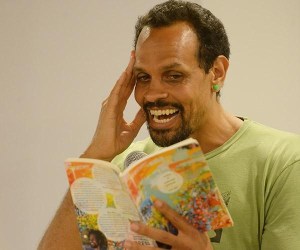
 Someone sent me a copy of “A Small Needful Fact”, its top right corner torn just a little into the words. It was the first poem of Ross Gay’s I had ever read, and since, I’ve been hooked by this poet-community orchardist. One year, I memorized and performed his “Ode to the Puritan in Me” for one of our poetry classes. It’s a poem whose words seem to tumble from themselves, coming from some unsourceable place, and trilling outwards until no reader can deny an impossible beauty in the world. Gay somehow manages to take the smallest, most personal moments of our existence, and string them out further, and further, making the reader gasp and feel the sky somewhere above them, the rich dirt somewhere beneath them.
As a nature lover, there was something instinctually grabbing about Gay’s poetry. He often draws from his experiences as a community orchardist in Indiana in his most recent book, A Catalogue of Unabashed Gratitude. As the title suggests, the natural world becomes a leaping-off point for entirely down-to-earth spiritual revelations in the form of deep gratitude. Gay works with trees and dirt and fruit to speak beyond the categories of natural and human. “A Small Needful Fact” is a response to Eric Garner, but instead of the brutality of his death, we get this delicate image of Garner’s hands, working for the “Parks and Rec. / Horticulture Department…put gently into the earth / some plants”. The image of these plants and all they serve is developed to a heartbreaking realization through the course of the poem of the fact of a life that was lost. It’s a political poem that sees, undeniably, human kind with a compassion more akin to a monk than a poet.
On a level of craft, Gay tends to linger on form that enforces the overwhelming revelation so often present in his work. In A Catalogue of Unabashed Gratitude, he tends towards long poems, covering several pages, but with clipped line breaks. Most notably, “Ode to the Fig Tree on Ninth and Christian”, one of the more recognized poems from the collection, with lines of about three words apiece. From the opening moment of the poem: Tumbling through the / city in my / mind”, the short lines are serving a clear purpose. This is truly a tumbling piece, a man slipping from city to tree to sweet figs to all the people standing around him, and onward to much larger ideas. The line breaks keep the reader digging, rushing along to see what comes next, and so we are kept in tempo with the speaker.
Reading this piece on the verge of my own true poetry education, I began to realize the purpose poetry serves in a world that has prose to tell stories and communicate characters. A poem cannot be really read without becoming part of its collective experience. The form often forces us to do so in an immediate sense. The associative leaps, a few moments later, really take the brain spinning into another experience, accepting the limitations and lens of this new world by becoming it. Inspired by Gay, I began to take risks with form: at first with the obvious line clipping, and then by gently weaning my narrative frame of thought towards something more honest to the human thought, allow myself to take some leaps when writing.
Ross Gay teaches me, every time I read his lines, of a larger and deeper unity in the world than we can normally imagine. He also teaches me, as a writer, to expand my definition of what will connect with a reader, and become more honest on the page: whether that honesty is through form or subject.
– Ana Shaw, Senior Editors-in-Cheif
 The piece “Escape” by Maya Halko, which appears in the 2017 print edition, always strikes me. Every time I come across it, I find something new that I hadn’t noticed before. I am mesmerized by the flow of the lines and the simplistic black and grey coloring. The fish placed in the bowl rather than another astronaut pulls the whole piece together.
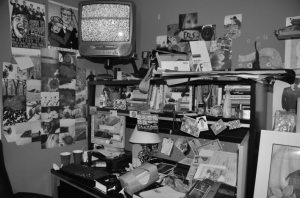 This piece, for me specifically reminds me of how much of a mess things can be, but still have beauty in it. There are so many object places on desk, the floor, and the sides, and for some reason I find comfort to that. The picture in general, seeps creativity. There is no emotion to evoke in the art because that’s not the point that it’s trying to prove. The point is that it’s trying to show the life of an art student. As I was looking through the book, there were so many pieces that we great don’t get me wrong; however, the fact that there was so much going on in the piece, it was also in black and white. It could’ve been colorful, which would have made every object illuminate more, but it wasn’t. And that’s what is so great about it. I always find myself attracted to blank things in general, because I know there is more to it. I also picture life as in that way, so I think that’s why is resonates so much for me. This desk has paintbrushes, paintings, books, paint, etc. Instead of it being an organized desk, no, no it’s an art student’s desk. That leads to how it represents Élan. As a writer, I myself like to messy, but only because it sparks for something for me. If everything was so clean and cut, you do not have a lot to work with it. That’s how Élan is. Élan works with the strangest writing pieces and art pieces, and that’s what makes us so unique. The community grows off of creativity
 elanlitmag.org