
 As we close in on Élan’s 30th consecutive year in publication, it’s important to remind ourselves why we’ve made it this far and why we’ll continue to publish in the future. So often, young writers are marginalized by their age, lack of experience, societal status, and perceived lack of skill. Most “big” publications skim over these authors, mistaking those qualities for an inability to craft a compelling story full of depth and growth.
The youth’s perspective is one often distorted by social media and trends. It’s because of this that the young person’s perspective in literary communities is all the more important. The stories of people our age are just as important (in some cases, more important) as the stories written by established writers, particularly in these developmental years where so much is unknown to us. And not the post-adolescent Judy Blume novels written by an adult on the life of a young person, but actual stories written by actual young people motivated to share their own truths, flawed as they may be. We’re all born into our own reality that’s continuously shaped by our experiences. With each story told, we chip away not at the answer, but at the question. Élan does so much more than share the works of young writers. It keeps young writers from slipping through the cracks. It shares the stories we love hearing and forces us to listen to ones we don’t.
Élan’s 30th anniversary marks an important milestone in more ways than one. In some ways, it proves naysayers wrong by reminding the community of the drive and motivation of young people to tell stories. In others, it reminds us writers there is demand for our work, and sometimes, all it takes is that boost to bring us back to why we do this. To chip away at the question. To stick it to the man. To tell a badass story.
-Tatiana Saleh, Community Outreach Editor
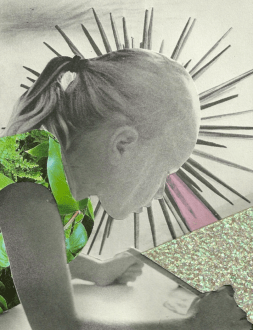 I never fully understood the meaning of community until I came to Douglas Anderson to study creative writing. Previously, I’d attended an arts middle school for theater, where I found life-long friends and transformed from a shy writer churning out pages and pages of fiction in her free time to a boisterous, enthusiastic performer carrying polished monologues under her belt. I auditioned for both theater and creative writing for Douglas Anderson—the first only to see if I’d get in, and the second with the actual desperate hope of getting in. After being accepted for both, I was forced to make an important decision I’d already subconsciously made years before. Because writing holds much more significance to my personal growth and future, I chose writing.
 I have always been a regular of libraries, often running around in the children’s section when I was younger, and musing over poetry in nonfiction when I was of age. But it did not occur to me until I was older that libraries were an establishment that played a vital role in my own community. Not only promoting literacy, but hosting community workshops which inspire and educate. In the children’s department, they put on an event, “Superheroes Read,” where kids dress up as superheroes and keep a list of the books they’ve read. Running around in capes, they come to associate reading with a positive memory. For teens, they host writing contests, where submitters write a story to a theme, and volunteer at the library to be considered eligible, thus fostering artistic creativity.
 elanlitmag.org