 I’ve always dreamed of being the Red Ranger from Mighty Morphin Power Rangers. He led everyone and sought wisdom whenever he needed direction. Though brash at times, he did whatever it took to protect and enlighten his fellow rangers. But what happens when the morpher isn’t working? What happens when the megazords and ferocious monsters leave the screen? Finding superheroes beyond the screen was always a challenge since I wasn’t as avid of a reader as I am now. I skimmed over Shel Silverstein’s poetry, knew every shade of Brown Bear, and scarcely remembered Dr. Seuss’s intricate rhyme schemes. But in middle school, I encountered Jacqueline Woodson’s Locomotion, a book about a young man that used poetry to talk about the trials of his life. After I read her book, I made it my mission to meet Lonnie.
I looked everywhere I could — on websites, social media, newspapers, but nothing ever came up. I eventually gave up and stopped looking for Lonnie since he hadn’t shown up. But about four weeks ago, Lonnie’s “mom,” Jacqueline Woodson, popped up. One of my mentor’s sent me an application for her workshop and I filled it out as soon as I got it. After waiting for my acceptance, I thought long and hard about Lonnie again, pondering. I wonder if Lonnie is her son or nephew or someone she knows. The curiosity grappled me again and reached a new peak as soon as I found out that I was accepted into her workshop. Finally, I thought, I might just get to find out about who Lonnie really is.
During the workshop, Ms. Woodson discussed her past books, Locomotion, If You Come Softly, After Tupac and D Foster, and her recent National Book Award winning memoir, Brown Girl Dreaming. I became infatuated with her immediacy and connectivity with her work. She rattled off sections of her past books as if she were reading from the page. I couldn’t believe that she had memorized whole sections of a book. But I figured since it was her work that she ought to know it. One of the students asked her if Locomotion was real, and she said he wasn’t. I was a bit saddened but I understood when she told us, jokingly, that “Fiction is just professionally lying.” We laughed and continued to inquire about topics ranging from her books and suggestions for building a better story to even her friendship with her editor. After participating in the writing exercise, all of the other younger writers took pictures with her and dispersed back to their parents while I walked with her through the Ritz. Her eyes shone as she walked, analyzing everything that good old LaVilla had to offer back in the days. As we walked through the museum, she inquired about everything, even one of the tag-lines of a photographer. When we walked towards the end of the museum, we talked about one of Jacksonville’s greatest and unfortunate tragedies — Ax Handle Saturday.
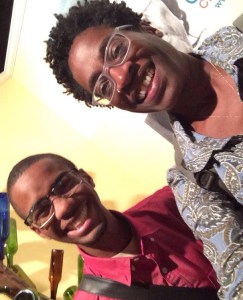
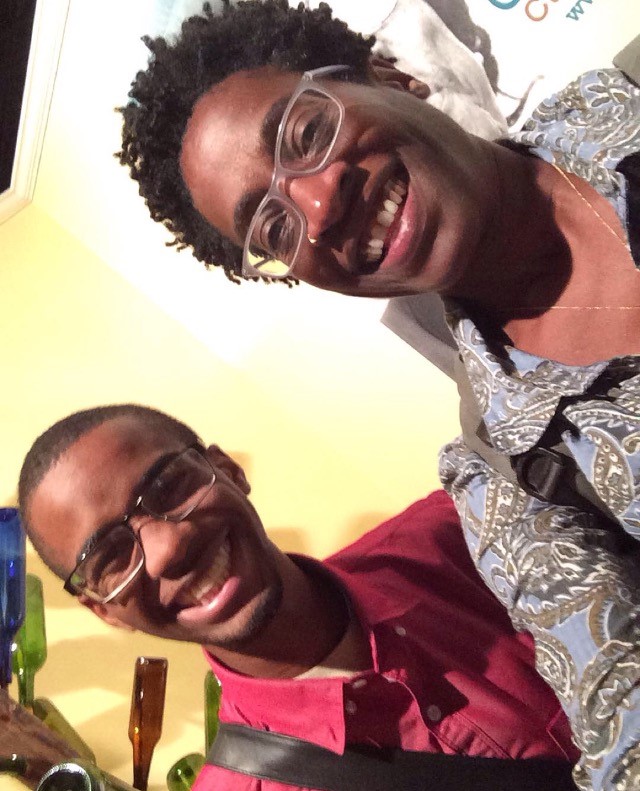
As I explained the nuances to her, she looked with disbelief. She wanted to find more of the history that had been hidden in Jacksonville. I then told her about the Kingsely Plantation and a story that I had created from my last visit. She became so engaged that we even discussed the Gullah Geechee people and their relevance in the south and even possibilities for stories about them. Before she left, she signed my journal and took a picture with me. As I waited for my mom to pick me up, I realized that I was Locomotion the entire time. Lonnie and I starting writing and learned the power of words around the same time. I guess you could say that you become your superheroes when you look up to them long enough. That’s the best part about Fall — the best things will hit the ground someday. We just have wait until they are ready.
-Dwight James III, Senior Marketing & Social Media Editor

 Community has many definitions. It is defined by Merriam-Webster as “a unified group of individuals,” “a group of people with the same interests,” or “a group of people with the same interests [or backgrounds].” These definitions are not mutually exclusive, but extremely varied. First appearing the late 14th century, from Latin, the word was primarily used to mean “a body of fellows or fellow-townsmen,” but also had additional meanings, including “a community of relations or feelings.” The word, in layman’s terms, implies a unification, whether due to geography or interest.
 elanlitmag.org