Spring: Breathing New Life into Élan

One of my favorite pieces in our Spring Book is a story titled, “By the Cornfields.” And while I typically prefer reading poetry over fiction, there is no denying the masterful craft involved in creating a full narrative in 310 words.

There is an eeriness to the piece’s voice that is unlike any Élan submission I’ve ever seen. The speaker is so well characterized through their sparse dialogue, and looming environmental details, that such a mall word count seems impossible. I especially like the bluntness taken on at certain times in the piece. At one point the speaker says, almost directly to the reader, “She was too old to be worrying about me. I was too old; men my age wake and can’t find comfort in their beds again. And that’s that.” The voice relays such certainty despite their seemingly constant paranoia. It is extremely satisfying to observe a character with so many layers in a microfiction piece.

Length aside, I truly admire Reece’s piece for its uniqueness. We get a pretty large array of Southern Gothic submissions tackling tropes and archetypes we are all too familiar with. We also get a lot of submissions displaying the dynamics within a marriage—the certain unavoidable conflicts, or a struggle for power. Reece manages to display elements from both of these things in a way I’ve never seen before. She creates a hellscape of sorts: in the country— out in the middle of nowhere—where a man favors his delusions over his wife, and the farm around him symbolizes the insanity (or evil) taking over him. I can’t put into words how much I enjoy this piece, and how proud I am to include it in our Spring Edition.

The uniqueness I mentioned in regard to Reece’s fiction can be said about a lot of our submissions this issue. As far as art goes, we got a fair number of abstract pieces that are typically hard to come by. Beautiful works such as Maverick Johnson’s Earth’s Sensations and Tamia Brinkley’s Composition 9721 helped evolve Élan’s voice from Fall to Spring; and even the pieces themselves display a kind of movement that perfectly matches the symbolism behind spring: renewal, rebirth. That being said, our book also does a great amount of work to contradict the typical messages of Spring. Some of my favorite pieces delve into hauntings of the past—such as Breana Kinchen’s “Oranges” or Jasper Darnell’s “How You Learned to Sleepwalk.” I think we cover almost every possible human emotion from cover to cover.

This Spring Issue will be my second-to-last book as Editor-in-Chief. Looking through the rough draft of the book, I couldn’t be more happy with what we managed to accomplish during this hectic time. I’m also extremely proud of my Junior Editor-in-Chief, Zoe, who took the Spring Issue on with great leadership and control. Everyone single person on this staff has grown above and beyond their role—and for that I am also proud.

I’m immensely grateful for the wonderful teen artists who make this book possible. I’ve never wanted Élan to have a “voice,” but rather, an ever-changing collection of voices. As an editor on the Élan staff, we don’t have the power to control what pieces get submitted: only which ones we choose to publish. It is important to us that all genres, all backgrounds, all topics, get their fair share of space in our publication. This issue ranges from helping a loved one with dementia, to visiting a father in jail, to an American Heritage Girls camping trip. The options are truly endless.

And seeing this end result, I truly think the founding Élan staff from 35 years ago would be proud of their legacy.

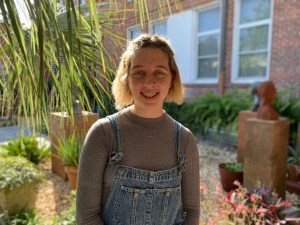
Olivia Meiller, Senior Editor-in-Chief
Writers’ Fest Through New Eyes

This year’s D.A. Writers’ Fest will be my first– a mistake I can blame only on myself.
I was a 14-year-old freshman the first time I heard of Writers’ Fest, and decidedly didn’t have enough foresight to attend. I said I’d go the next year, but by the time the next year had come around and my excitement had grown, I learned that Writers’ Fest was an every-other-year event which I’d only get two opportunities to attend as a high school student, one of which I’d just missed.

So now, after a long wait, I’m prepared and beyond excited to attend my very first (but not last) Writers’ Fest this coming March. I’m especially excited about this year’s line-up of writers, which boasts a variety of writers from poets to playwrights with diverse and unique styles and experiences. Among the ranks of this lineup of acclaimed writers are two in particular that I’m thrilled and eager to learn from: poets Terrance Hayes and Franny Choi.

I was introduced to Terrance Hayes earlier this year during an author study project focused on identifying craft choices that make up an author’s unique style. Two of these craft choices that had an impact on me were his innovation of poetic structure, and his focus on the emotional impact of the language itself.

In a reigning age of free verse, Hayes makes a mark in his use of poetic format. For example, in his most recent collection, American Sonnets for My Past and Future Assassin, Hayes explores historical, current, and future violence against black men through fresh takes on the sonnet form. Hayes’ use and innovation of structure is an inspiration to both the seasoned and aspiring poet, a reminder of why we grew to love poetic form in the first place, as well as the place it has in contemporary poetry.

And his “language first, meaning second” approach to poetry– a pursuit of using language to replicate feeling as purely as possible, creating poems where the language affects you before you try to rationalize. The results of this endeavor are poems like “Hip Logic,” evocative beyond measure, cinematic and visual in nature. It comes as no surprise that Hayes was a painter before he was a poet.

Like Hayes, I first encountered Franny Choi in the classroom, but under very different circumstances. It was my sophomore year, my first year in the D.A. Creative Writing program, and my first real brush with poetry. I’d written poetry in the past, but always under a deadline, always for a grade. I never considered myself a poet, and harbored a harsh and unfounded disdain for contemporary poetry. But here my teacher was, with a stack of poetry books, anthologies, and magazines, asking that I read and try to connect.

This is the process that led me to an armchair in the back of the classroom, holding a back issue of Poetry Magazine, searching for a poem to read. The poem I found was Choi’s “Perihelion: A History of Touch.” It wasn’t the poem I was looking for, a poem that was short and easy to understand, but instead one that was winding and took some patience– and yet it was the poem that moved me forward in my poetry. It was an inviting mix of the familiar and unfamiliar; reminiscent of the magical realism I loved, but still something I hadn’t been so sure about until that point: a poem.

Given that Choi has had such an impact on my story as a writer and as a poet, I’m thrilled to have the opportunity to learn from her and her writing this Writers’ Fest, and likewise, to learn from Hayes and his craft, as well as the other writers in the lineup.

The existence of Writers’ Fest really is a feat– for a public school to pull off a festival of this magnitude and prestige is a testament to the strength of the ever-growing arts community in Jacksonville. I can’t wait to see what these amazing writers and this amazing community has to offer, and I’m hoping my attendance at this year’s Writers’ Fest and all of the Writers’ Fests of the future will make up for the ones that I’ve missed. 

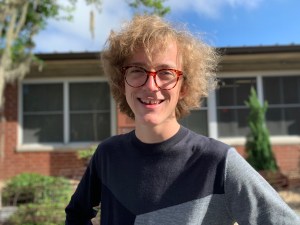
Blake Molenaar, Junior Art Editor

On Writers’ Fest

When I went to Writers’ Fest in 2018, I had the pleasure of meeting and being taught by George Saunders. When we had this last Writers’ Fest, Saunders was getting ready to circulate his new book, Lincoln in the Bardo. After being taught with examples from his short stories which were nothing short of excellent, I was very keen to hear him speak on craft, and to share with us his insight into the cognition and execution of the creative impulses surrounding the short story.

His seminar was indicative of what his students must experience at Syracuse. To have that intimacy and opportunity for interaction with the learning process was something that would be inaccessible from a traditional, large scale seminar, or a auditorium experience. Saunders spoke in depth about his creations and the process of developing meaningful components like characters and action within short fiction and how they can move the story forward through immediacy. Through this immediacy, he and my teachers claimed, was the key to authenticity and how readers could be brought into the space we as writers need them to be in.

Following his presentation and lesson, which was the most advertised and awaited, we were brought into a rotation of smaller seminars and lessons by other writers with an even smaller class, or group to create with. Each writer brought their specialty, or technique to be brought into a classroom setting for distribution, possibly for the first time. We were being given access to what so many people needed to hear, and what was so inaccessible otherwise. Another one of my favorite lessons was from Yvette Angelique Hyater-Adams. She brought with her a “braided story technique,” something that was entirely foreign to me at the time. Through her workshop, which focused on bringing two stories together and intertwining them to create a central narrative, I created my next portfolio story using the technique. This concept of using two influences was echoed in a later workshop where I learned “the jazz method” of writing poetry. This was by far my favorite workshop, and I still use the technique today when writing poetry. The process calls for the integration of a concrete narrative, or predetermined sequence of words or phrases that could be written together to create narrative. This concept of adding arbitrary constriction on the creative process to ignite and instigate new ways of creating is something that I have since praised as the greatest way to access creativity. My mother’s company is built upon the ideas of treating those with brain injury with creative instances similar to those with restrictions similar to that from the workshops. I wrote most of my poems from that year using some degree of predetermined sequencing in order to “write around” the problem, thus creating something entirely new.

I will take with me forever into my writing processes the lessons learned form the elite writers procured by the Writers’ Fest administration. Their insight into craft, and suggestions regarding creative approaches to the issues of the common writer were something that is simply not available outside of that setting and opportunity. For that reason, I am incredibly excited about seeing such talented writers return to our space again and impart more wisdom for the class to execute on.

Sheldon White, Junior Fiction/CNF Editor