
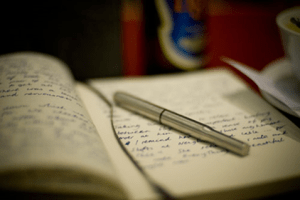
 I don’t think there has been a very specific moment in my life where I’ve lost my love for writing. I believe I’ve had a number of little moments where I felt like giving up on writing for many reasons; whether I was stuck in a piece or couldn’t get a piece started at all, or I was just disappointed in what I wrote, that it didn’t feel like I’d taken the writing to its full potential. I could never imagine myself totally giving up on writing. I can’t help but write every day, not just because of classes and assignments, but also because my need to put down the things I see. I observe my surroundings and in them, I find characters, plot and conflict, abstract ideas. These things I put down, mentally at the time, then later on paper. Truthfully, I don’t immediately put these ideas to the test in a piece. I write fragments and leave them as is.
Although jotting down ideas is a part of being a writer, it is nowhere near the full scope of writing. At the beginning of each school year is when I, in a way, reboot myself as a writer. During the summer, I never find time to write pieces and hardly find time to read. It’s not necessarily that I lose my love for writing, it’s just that I lose some of my abilities. I become unfamiliar when I’m away from it for too long. I attribute my ability to rekindle my love for writing to my teachers and peers. Again, I regain it at the beginning of school. Assignments in creative writing can be very stressful because they require a lot, mentally and emotionally. Being in the class environment with people who have the same love for writing as I do and knowing that they understand is encouraging. It’s a reminder that I’m not alone and that it’s not just a grade, it’s practice within my craft. I’m forced to clean off the rust of not having written anything for two and a half months.
Another way I rekindle my love for writing is reading other people’s work. It’s another way of understanding that I’m not the only one on a journey to knowing myself, things instilled in me and around me, things I know too well and don’t know at all.
–Lindsay Yarn, Digital Media Editor
 It was towards the end of last school year when I lost my love for writing. All my pieces seemed lack-luster and dull, due to a combination of the persistent tiredness that usually rooted itself around all of the tests in May, and a lack of inspiration from a year of nonstop writing. I found myself hopelessly jotting down story after story and doing everything I could to finish out the year strong; I would make character maps and force myself to journal every day and endlessly research ways to regain what I had lost, however nothing seemed to work and once school ended, all of my efforts seemed useless and I gave up once and for all, taking the time off to stop stressing about what I was putting down on the page and focus more on relaxing.
 Becoming Junior Editor-in-Chief this year on Élan has taught me about writing in ways I didn’t expect, because being editor isn’t just about organizing people or putting together the editions. It’s about cultivating a collection of work that defines the publication. My role forced me to look at writing not just for its individual value, or my person connection, but from a critical eye: seeing the merits in work I don’t immediately connect to, defining why a piece matters outside of my personal experience. When we were reading for the spring book, I had to step in for the first time and make executive decisions about every piece we published: Did it represent Élan? Did it show thoughtful and professional technique? In the end, learning to identify the techniques of a piece of writing has given me a new approach to my own art.
 elanlitmag.org